Get AI Briefings, Transcripts & Alerts on Local & National Government Meetings — Forever.
TregoGrid proposes 25-acre battery storage facility near Talus Valley; annexation and CUP advance to Planning Commission
Summary
The Ward 3 advisory board heard a presentation from Wood Rogers and TregoGrid on a proposed battery energy storage facility to be sited adjacent to Mira Loma substation. The project would annex a 53.5-acre parcel and use roughly 25 acres for unmanned Tesla battery units; reviewers asked about fire safety, noise, wildfire risk and annexation timing.
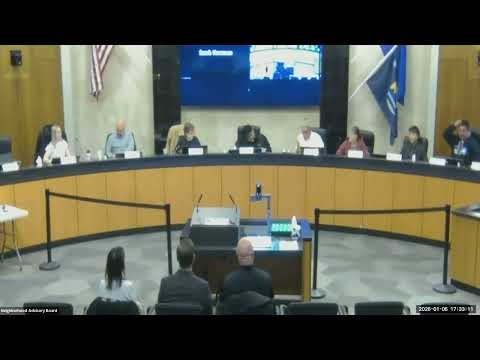
TregoGrid representatives and applicant consultant Eric Hasty told the Ward 3 Neighborhood Advisory Board on Jan. 6 that they seek annexation of a 53.5-acre parcel and a conditional use permit to build a battery energy storage facility using about 25.5 acres adjacent to Talus Valley and the Mira Loma substation.
The project would change the parcel’s zoning upon annexation and place battery “megapacks” near an existing substation to charge during low-demand periods and discharge during peaks to stabilize the regional grid. Hasty said the installation would be unmanned and tied to the substation’s existing lines; the company is working with NV Energy under an agreement identified in the presentation.
Why it matters: the facility is intended to improve grid resiliency for South Reno and the greater Northern Nevada transmission network without building a new generating plant, proponents said. Opponents and neighbors raised concerns about fire risk, continuous operational noise, visual impacts, and wildfire exposure given the hillside location.
What presenters said: Eric Hasty (Wood Rogers), presenting for the applicant, described the application as two linked items — annexation and a CUP — and said the facility would locate near an NV Energy substation. He described four CUP triggers the board must consider: establishment of a major utility use, hillside development conditions, fills greater than 10 feet (maximum 12 feet proposed), and residential adjacency mitigation (SEG 550-569). Hasty said the applicant submitted the application in December and tentatively expects Planning Commission review in February (SEG 654-659, SEG 657-659).
On safety, TregoGrid’s fire consultant Brian Scholl of Energy Safety Response Group described the planned battery chemistry as lithium iron phosphate and said those units are “much safer, much more stable than the previous ones” and are subject to NFPA 855 and the International Fire Code. He added that unit-level suppression and monitoring are standard, and that the company will create an emergency response plan and annual training for first responders (SEG 919-931, SEG 941-949). Scholl said the likelihood of an event is very low with modern chemistries (SEG 950-955).
Applicant clarifications: Remote applicant representative Ricardo Betts emphasized TregoGrid is not NV Energy and that TregoGrid’s corporate office is in Burlingame; he said the company responded to an RFP and partnered with NV Energy because of grid needs at that location (SEG 870-881).
Community and board questions: board members pressed for details on fire suppression (Hasty said hydrants were an applicant decision intended to support wildland fire response, not to extinguish battery fires), manufacturer/ownership (presenters said Tesla would supply battery units), noise and mitigation (the nearest home was described as about 750 feet away; the applicant proposed 8-foot CMU walls, vegetation buffers and a noise study; applicant cited a conservative 75 dB manufacturer measurement at 10 meters under maximum operating conditions), and how wildfire, flooding and drainage would be managed (presenters described defensible-space roads, block walls, detention basins and elevation of equipment above expected flows) (SEG 661-703, SEG 969-1114, SEG 1211-1220, SEG 1268-1291).
Next steps: the project team said annexation must be completed before construction; the application moves next to city planning staff and a Planning Commission hearing is tentatively scheduled for February (SEG 656-659, SEG 821-827). TregoGrid representatives said the facility will be monitored 24/7 remotely with periodic O&M visits; the facility is expected to be unmanned for day-to-day operations (SEG 1335-1346).