Lifetime Citizen Portal Access — AI Briefings, Alerts & Unlimited Follows
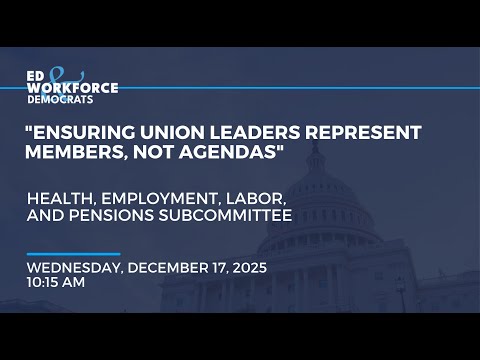
House subcommittee hears competing views on LMRDA reforms to expand member access and curb employer 'union‑busting'
Loading...
Summary
The House Education and Workforce subcommittee heard testimony from workers, advocates and researchers on proposals to amend the Labor Management Reporting and Disclosure Act to require greater disclosure to union members, guarantee member votes on contracts and strikes, and strengthen enforcement against employers and consultants accused of anti‑union activities.
Republican and Democratic members of a House Education and Workforce subcommittee traded sharp views during a hearing on proposals to update the Labor Management Reporting and Disclosure Act, with witnesses describing both gaps in union transparency and persistent, underenforced employer and consultant practices that can undermine workers' organizing rights.
Chairman Rick Allen opened the hearing by framing the bills under consideration as measures to "better support union members who want to participate in governing their unions" and to restore the LMRDA's original promise that unions be "democratic, transparent, and responsive to their members." Ranking Member DeSaulnier countered that "you cannot be pro worker and anti union," and stressed the need to hold employers that illegally interfere with organizing accountable.
Witnesses gave contrasting but sometimes complementary testimony. Nathan McGrath, president and general counsel of the Fairness Center, told the subcommittee that many clients have been "stonewalled" when seeking basic union documents and that the law was intended to safeguard members "when a union becomes an employee's exclusive representative, that worker loses significant autonomy." He said removing or reforming the requirement that members exhaust internal union procedures for four months before seeking court relief would help aggrieved members avoid a process he described as biased and intimidating.
Michael Alcorn, a crew member at Trader Joe's who said he is a visiting fellow at the Institute for the American Worker, described his store's organizing campaign and alleged that workers were misled about authorization cards, that officer elections were held with limited notice and that leaders prioritized political demands over workplace issues. "We were misled," he said, and urged Congress to require more disclosure and secret‑ballot protections for officer elections and contract ratifications.
Bob Funk, executive director of LaborLab, focused on enforcement gaps on the employer side, saying unions comply with annual disclosures at high rates while many employers and anti‑union consultants do not. He cited that "83% of unions get their annual financial disclosures in on time" versus "34% of employers and anti‑union consultants" and urged the Department of Labor to create a functioning tip line and to enforce persuader‑activity rules so workers know who is trying to influence them.
Democratic members pressed back against what they described as a hearing that unfairly targeted unions. Representative Summer Lee said hearings like this are "another opportunity for Republicans to go after workers," and stressed that corporations and consultants also deserve scrutiny for spending millions on anti‑union campaigns. Several Democrats pointed to workplaces and unions that already post collective bargaining agreements and hold contested officer elections as counter‑examples to the portrait of union misconduct.
Throughout the session, members and witnesses discussed several bills the committee is considering, variously referenced in testimony as proposals to: require unions to provide members with copies of collective bargaining agreements, constitutions and bylaws; guarantee secret‑ballot elections for union officers, contract ratifications and strike authorizations; and remove the four‑month internal exhaustion requirement in some cases (referred to in the hearing record as bills '61 39', '61 41', and '61 42' and specifically HR 61 41, described as the Fair Access to Justice for Union Members Act). Witnesses said some of those changes could help members, while also urging the committee to address employer compliance and consultant disclosure.
The committee left the hearing record open for 14 days to accept additional written statements and evidence, and recessed briefly for a series of House floor votes before reconvening. No committee votes on the bills were taken during the hearing.
What happens next: Members said they plan to continue work on LMRDA‑related legislation. The immediate procedural step taken during the hearing was to leave the record open for 14 days for additional submissions.