Get Full Government Meeting Transcripts, Videos, & Alerts Forever!
Get email alerts on the Community Funding topic
No spam. Unsubscribe anytime.
Community groups urge Contra Costa to spend remaining ARPA/contingency funds on food security and rental assistance
Summary
Dozens of nonprofits and residents urged the Board to allocate the county's remaining contingency/ARPA dollars toward immediate hunger relief ($5M recommended) and rental assistance ($3M recommended). The board approved several district-level allocations and agreed to return Dec. 16 for a countywide funding decision after health and housing updates.
Dozens of community leaders and service providers told the Contra Costa Board of Supervisors on Nov. 18 that the county should prioritize food security and rental assistance as federal and state program changes take effect.
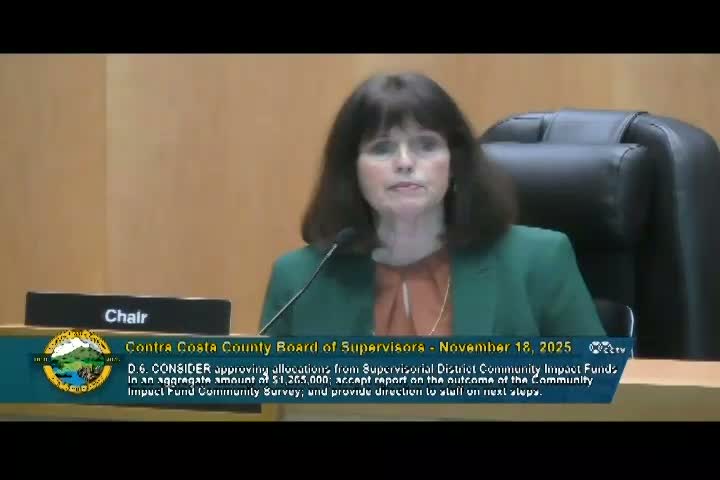
Tim Ewell, chief assistant county administrator, reviewed the Community Impact Fund's background, the county's public survey (2,578 respondents) and the staff recommendation to approve specific district-level allocations totaling $1,265,000 (attachments A and B). Ewell noted $9.7 million remains in a contingency appropriation tied to COVID/FEMA reimbursements and explained that drawing from that appropriation requires a four-fifths vote of the board.
Public plea for immediate relief: Food-system leaders asked the board to allocate $5 million for immediate hunger relief and an additional $3 million for rental assistance and housing stability. Testimony came from Food Bank of Contra Costa & Solano (Caitlin Slye and partners), Meals on Wheels Diablo Region, Loaves & Fishes, White Pony Express and dozens of smaller pantry operators describing surges in demand and operational needs (refrigeration, vehicles, kitchen expansion, volunteer coordination). Several providers reported sharp spikes when SNAP/CalFresh benefits were paused: one pantry reported daily clients rising from 250–300 to 325 and registered 110 new households since November 1.
Service-provider asks and specifics: The Food Security Collaborative proposed a countywide pool (requests included $5M for immediate operations and re-grants to smaller partners). Loaves & Fishes requested $1M for a new central kitchen to triple meal capacity from ~3,000 to ~9,000 meals/day; Meals on Wheels described plans to cover the county with one chapter and requested support to avoid service cuts. Community health centers and Planned Parenthood representatives also asked for targeted aid to offset federal reimbursement and coverage changes.
Board actions and path forward: The board approved, by motion and voice vote, the district-level allocations presented for Districts 2, 3 and 5 and authorized supervisors'designees to execute related contracts. Supervisors agreed to return Dec. 16 for a fuller countywide discussion of the remaining $9.7M and to receive the health department's update beforehand. Because the contingency appropriation requires a four-fifths vote to expend, board members stressed the importance of having all supervisors present for any countywide allocation vote.
What agencies reported: Food banks said they are stretched: partner agencies reported wait lists (Meals on Wheels home-delivered meals has a wait list of ~300 clients), and providers noted a need for capacity investments (vehicles, kitchen upgrades) as well as direct food-purchase and regranting funds. Several speakers emphasized that smaller faith-based and neighborhood pantries need accessible grant streams to purchase refrigeration and vehicles.
Next steps: Staff will post the interactive community survey dashboard and work with district offices and departments to prepare a detailed December briefing (health impacts, housing authority status, and proposed countywide allocation options) to inform a four-fifths vote if the board chooses to spend contingency funds.