Get Full Government Meeting Transcripts, Videos, & Alerts Forever!
Get email alerts on the State Federal Budget topic
No spam. Unsubscribe anytime.
Contra Costa officials warn of steep local impacts from HR 1 and state budget changes
Summary
County staff told the Board of Supervisors that HR 1 and the state budget contain large cuts and new administrative responsibilities that already cost Contra Costa $24.2 million this year and could grow to more than $250 million annually in coming years; supervisors discussed mitigation, advocacy and possible local backstops.
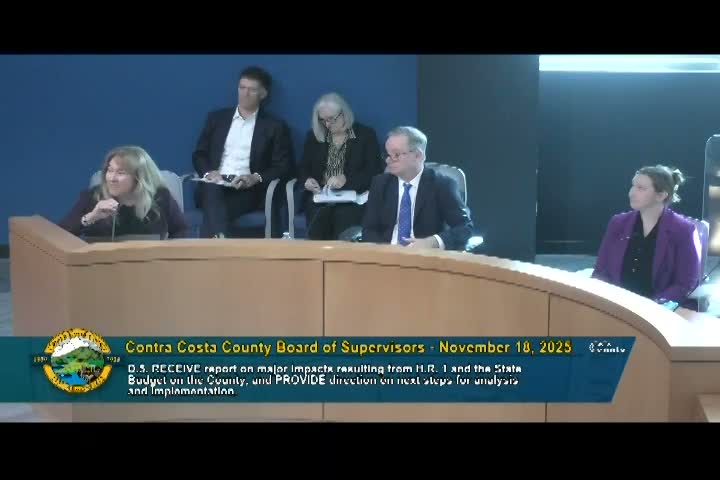
County officials on Tuesday told the Contra Costa Board of Supervisors that federal and state policy changes embedded in HR 1 and the 2025 state budget will have immediate and long-term fiscal and programmatic consequences for county services.
The board received a high-level briefing from the county administrator's office and legislative staff outlining the expected effects on safety-net programs, including CalFresh (the state's SNAP program) and Medi-Cal (Medicaid). Emlyn Struthers, the county's legislative coordinator, said HR 1 makes historic reductions to national Medicaid and SNAP funding and shifts both benefit and administrative costs toward states and local governments.
"These are policies that have been enacted into law," Struthers said. "We have already lost $24.2 million this year as a direct result of HR 1 and the state budget; those changes grow substantially in future years." She told the board the county anticipates compounding impacts across departments, with projected annual exposures in the hundreds of millions of dollars as enrollment and payment changes take effect.
Why it matters: county staff said the package of changes will reduce benefit purchasing power for recipients, add work and documentation requirements for enrollees and double administrative workloads in some eligibility units. For example, the county's employment and human services department has been told about new six-month redeterminations for many Medi-Cal expansion adults and expanded verification of work and community-engagement requirements for SNAP beneficiaries, increasing staff workloads with no identified new federal administrative funding.
Marla Stewart, director of the Employment & Human Services Department, walked the board through program-level impacts. She said the federal share of SNAP administration is reduced (moving from 50% federal to 25% in some provisions), which increases the state's share and, given California's 70/30 cost split with counties, will raise Contra Costa County's share of administrative costs by an estimated $5 million next year. Struthers and Stewart also cited a county-level estimate that, if the state average error-rate approach is used for SNAP, Contra Costa's share of benefit costs could be roughly $40 million annually.
Supervisors pressed staff on details and timelines. Supervisor John Gioia asked staff to quantify the gap between meals currently funded by the county's senior nutrition and home-delivered meal contracts and the growing demand; staff said the county would need roughly $382,000 this year (about $500,000 including vendor staffing costs) to meet current demand trends. Board members also asked for more clarity on how federal "payment error rates" are calculated and how much of those errors stem from underpayments versus overpayments; staff said the split is roughly half under- and half overpayments and that methodology varies by state and program.
Board direction and next steps: county staff asked the board to treat the briefing as the first of multiple deep-dive sessions and promised updated, program-level cost estimates in December and at the board's February budget retreat. Supervisors emphasized parallel advocacy through state and national associations (CSAC, NACO) to seek state backfills or policy changes and discussed local options to mitigate harm, including targeted one-time investments.
What the county cannot do alone: staff repeatedly told the board there is legal and regulatory uncertainty because federal rulemaking and state implementation guidance are incomplete; that uncertainty complicates precise forecasting; and that many of the harmful provisions phase in over several years, meaning the county must both plan for immediate costs and prepare for larger downstream effects.
The board asked county staff to return with more granular estimates for key programs (CalFresh/ SNAP administrative impact, Medi-Cal enrollment and renewal costs, hospital/clinic reimbursement impacts) and to outline advocacy options the county can pursue with state lawmakers and associations. No formal board action was taken on this presentation; it served as a planning briefing and as notice to the community that the county expects substantial budget stress ahead.