Get Full Government Meeting Transcripts, Videos, & Alerts Forever!
Get email alerts on the Property Access topic
No spam. Unsubscribe anytime.
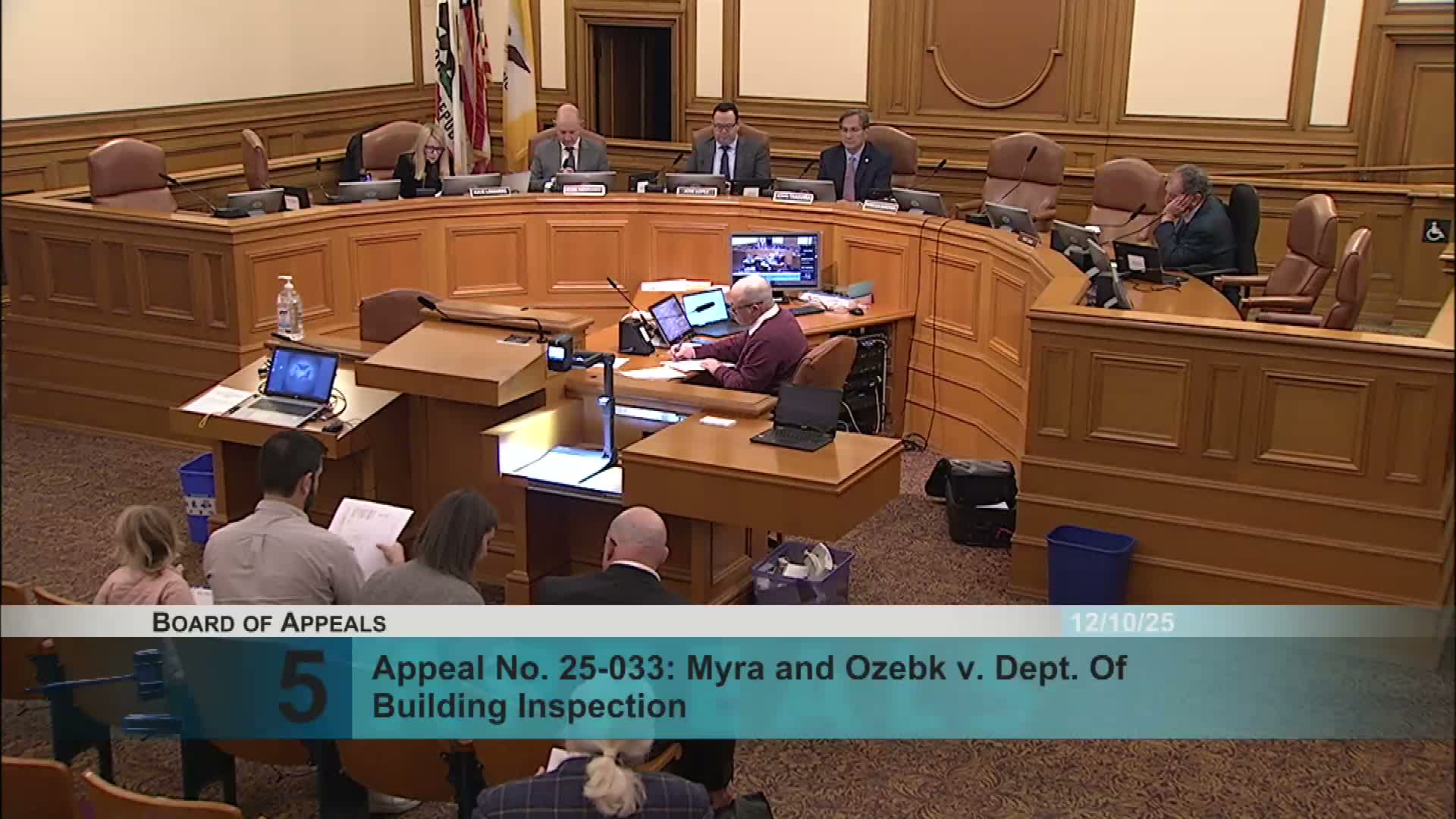
Board denies appeal at 506 Gates St.; commissioners urge better disclosure for property‑line access issues
Summary
After extensive testimony about a long‑standing access corridor and contested legal doctrines (prescriptive easement), the Board of Appeals denied an appeal over a two‑story addition at 506 Gates St., finding department reviews showed code compliance but urging systemic remedies like seller disclosure for property‑line windows/doors.
The San Francisco Board of Appeals on Dec. 10 denied an appeal by Sarah Lang challenging a permit for alterations at 506 Gates St., voting 3–0 to uphold the permit after hearing competing legal and technical arguments about property‑line doors, longstanding use, and whether a court‑level easement claim should block the project.
Why it matters: The case turns on whether long‑used access, windows and a small courtyard constitute an enforceable prescriptive easement or other private right that should prevent a neighbor’s code‑compliant addition. Commissioners and members of the public described the situation as a recurring, citywide source of hardship for owners living adjacent to properties that later build up to parcel lines.
What the board heard: Appellants’ counsel Jeremy Paul argued the enclosure and historic use strongly suggested a prescriptive easement and urged the board to suspend the permit so parties could pursue a quiet‑title action or negotiate. He described the space as functionally necessary for access to a basement laundry area and said the planning and architectural review failed to account for the practical impacts.
Permit holders and their counsel disputed an enforceable easement. Owner Alexia Martini and counsel Laura Strazza said the design is modest, that the permit record contains no recorded easement, and that equitable easement doctrines require clear and convincing evidence best resolved in civil court. Architect Fallon James explained that internal redesign options (tunnels, third floor or significant reconfiguration) were either infeasible under budget or could not meet code‑compliant egress while preserving essential bedrooms.
Department positions: Planning (Corey Teague) told the board the project is consistent with RH‑1 zoning, Bernal Heights rules and planning code; planning staff noted the permit showed the existing door and windows and that property‑line windows and doors are not protected under planning code or policy. DBI told the board the permit meets applicable building‑code requirements.
Commissioners’ response and remedy discussion: While commissioners expressed sympathy for the Lang family’s situation and acknowledged the long‑standing use of the courtyard, they concluded the board lacks a legal basis to overturn a code‑compliant permit. Several commissioners suggested a systemic response—recommended seller disclosures or a letter to the Board of Supervisors to address recurring property‑line issues and improve public notification of such risks.
Outcome and next steps: Vice President Jose Lopez moved to deny the appeal; the motion passed 3–0 (Trezwina Aye; Swig Aye). Commissioners asked staff to consider recommending improved seller disclosures and possible communications to the Board of Supervisors about recurring property‑line vulnerabilities.
Quoted on the record: Appellants’ counsel Jeremy Paul said there had been a “tremendous failure of imagination” and urged practical solutions rather than litigation. Corey Teague for planning said, "Purely from that perspective, these plans that I've reviewed are ... completely code compliant." The record includes discussion of design alternatives and the planning department’s advice that variances were unlikely.
Record notes: The hearing header listed permit number 202412116574; DBI testimony later referenced permit application 202505206917 in oral remarks. That discrepancy appeared on the record and was not resolved in the hearing.