Get Full Government Meeting Transcripts, Videos, & Alerts Forever!
Get email alerts on the Land Use topic
No spam. Unsubscribe anytime.
Residents and condo council push back on comp‑plan change to allow voluntary demolition; staff to clarify UDC/destruction test
Summary
Public speakers and the Siesta Key Condo Council urged the County Commission to table or reject a proposed comprehensive‑plan/UDC change that would allow voluntary demolition and rebuild of nonconforming multifamily condos; staff will return with a report clarifying the UDC "destruction" test, FEMA 50% interaction, and implications for nonconforming properties.
Public testimony at the Sarasota County workshop made clear a sharp divide over a proposed comprehensive‑plan amendment and Unified Development Code text change that would allow voluntary demolition and redevelopment of nonconforming residential multifamily (RMF) buildings on Siesta Key.
Speakers representing Protect Siesta Key, the Siesta Key Condo Council and the Siesta Key Association urged the commission to pause the publicly initiated amendment and to retain protections in FLU policy 2.9.1 that limit density and intensity on barrier islands. Carlyn Berghof (Protect Siesta Key) argued the proposal would create loopholes that could worsen density and infrastructure strain. Dr. Veil Schleifer, representing the condo council, said recent storms showed many owners prefer repair rather than demolition and cited roughly 137 RMF properties on the key that could be affected.
Supporters of allowing voluntary demolition — including Matt Brockway, a land‑use attorney and Siesta Key resident — said giving associations the voluntary option could enable older buildings to be rebuilt to modern, storm‑resilient standards. Brockway and others also urged the county to allow discretionary voluntary freeboard that would not count against height calculations so rebuilt buildings are safer without being penalized for resilience measures.
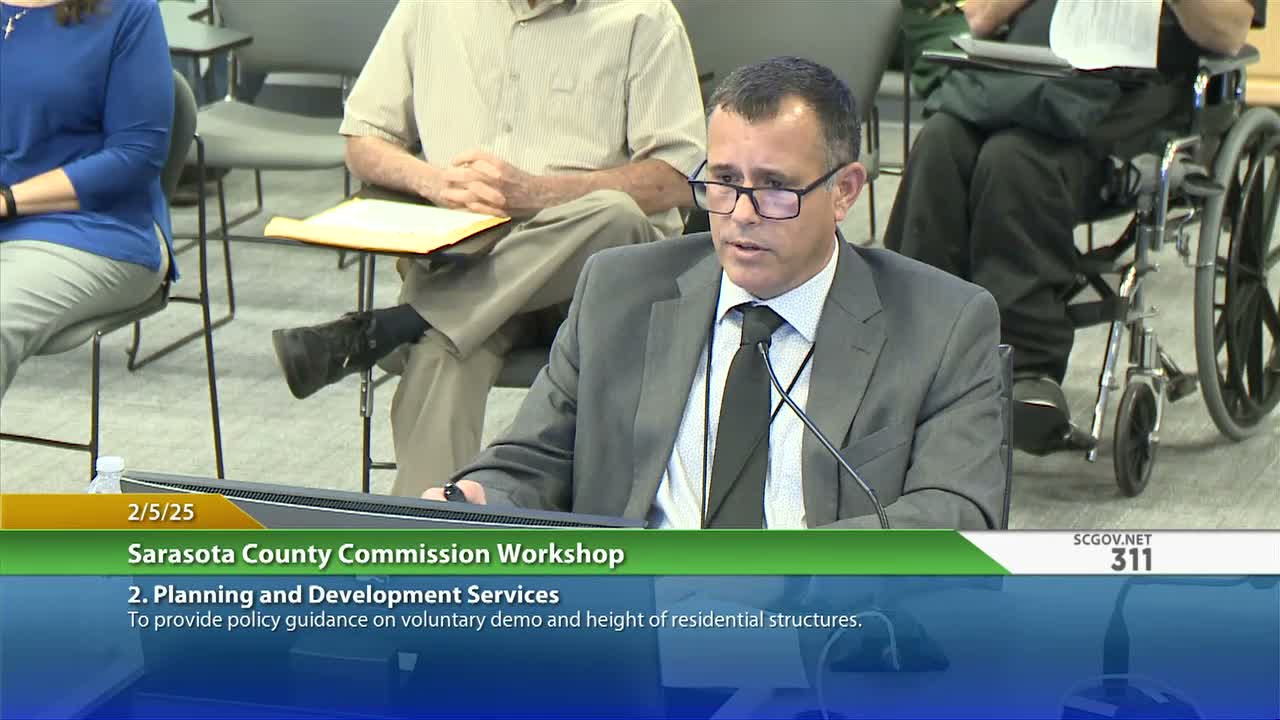
Commissioners asked staff to return with a fuller analysis of how the county currently treats nonconforming structures, what triggers rebuild eligibility (including how "destruction" is defined and how FEMA's 50% substantial‑damage test applies), and what procedural steps would be required for an association that seeks voluntary demolition and rebuild. Staff agreed to include those items in a follow‑up report and to discuss whether UDC language should be clarified before pursuing any comp‑plan amendment.
The workshop did not advance or adopt changes to the comp plan or UDC; instead the board asked staff to provide clearer technical definitions, examples of case pathways (repair vs. demolition), and ramifications for parking, lot coverage, insurance and infrastructure funding prior to any formal hearing or amendment vote.