Fairfax County task force reboots Phase 3 study, staff models about 5,465 new multifamily units to test transportation capacity
Loading...
Summary
Fairfax County staff told a reconstituted task force that Phase 3 of the Fairfax Center area study will test a transportation scenario that models roughly 5,465 additional multifamily units (an estimated 8,200 residents) to understand network capacity and guide future comprehensive‑plan guidance. Results are expected in early 2026.
Fairfax County planners reopened the Phase 3 Fairfax Center area study at a task force meeting, presenting a transportation‑testing scenario that models substantially more residential development than the current comprehensive plan to identify how the county’s roads and multimodal network would cope.
“Right now we’re looking at about 5,465, or so, estimated units throughout the core area,” Ryan Stewart, a county planner with the Department of Planning and Development, said. Staff used a 1.5 residents‑per‑unit assumption to estimate about 8,200 new residents under the scenario and made unit‑size assumptions (roughly 1,000 square feet) when converting FARs to unit counts for modeling.
The scenario is designed as a maximum‑impact test, Stewart said, not as a final recommendation. “This development scenario is for the purposes of testing the transportation network,” he said, adding that the transportation results will be used to refine what level of development is appropriate for the core area.
Why it matters: staff said the exercise will help the task force and county decision‑makers decide whether and where comprehensive‑plan guidance should be revised to accommodate more housing and future transit. Stewart said the county has already secured funding for the transportation study, and model results are expected in early 2026.
Staff emphasized the scenario’s role in testing network capacity rather than prescribing a final land‑use outcome. The county’s approach compares Fairfax Center to other suburban centers that have planned for higher intensities when mass transit arrives; Fairfax Center’s current adopted FAR guidance averages about 1.0 in key subunits but staff tested higher FARs at specific sites to capture potential redevelopment footprints.
Staffers also warned that residential growth has different local impacts than office or retail. “Residential uses have a generally greater community impact than office or retail uses,” Stewart said, noting that conversion of office to housing is a market trend observed elsewhere in the county.
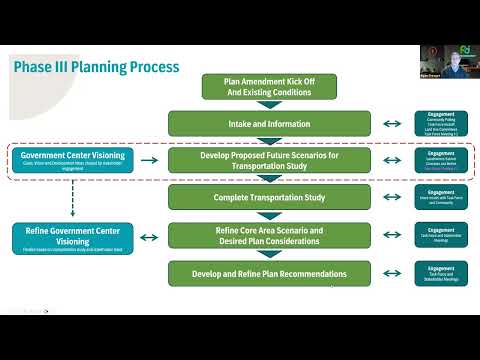
Next steps: transportation modeling results will be shared with the task force and used to guide subsequent discussions about draft plan text and possible site‑specific guidance. Staff said the county intends to hold more frequent task force meetings over the coming months to review results and dive deeper into topics such as placemaking, parks, and street‑level design.