
Committee discussion zeroes in on CAFO rules, stakeholder group and need for funding to implement practices
Get AI-powered insights, summaries, and transcripts
Subscribe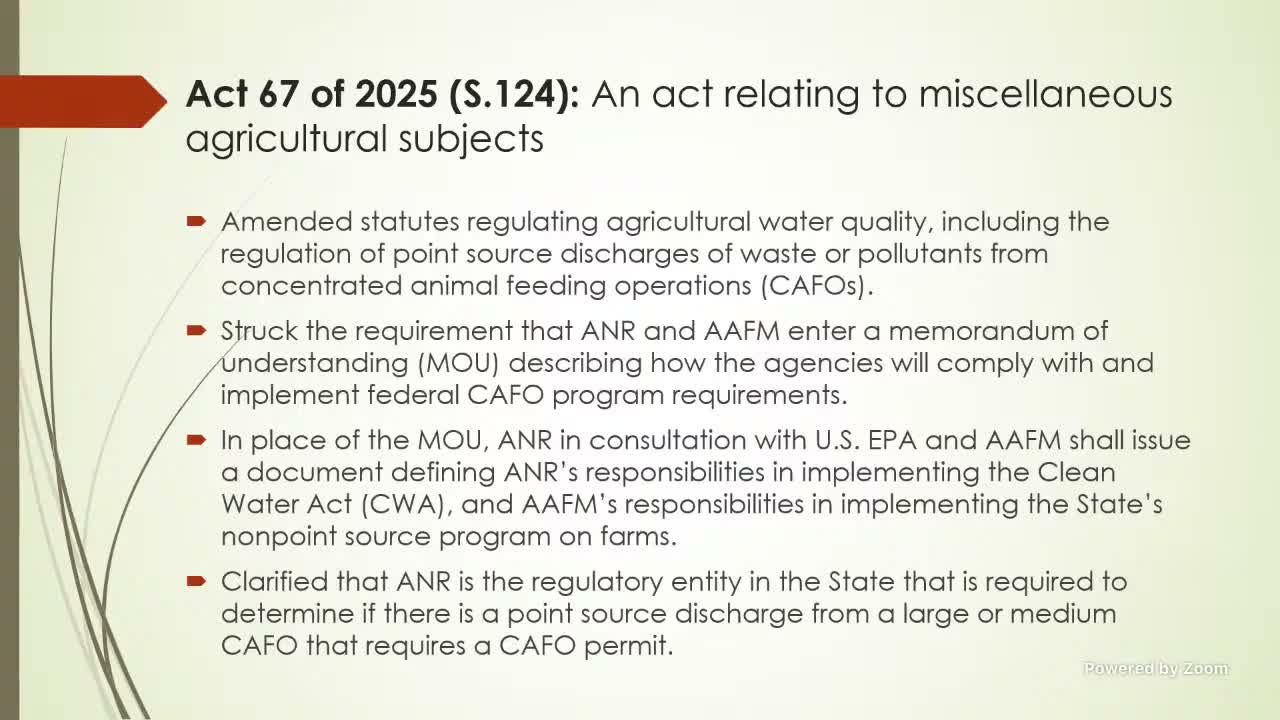
Summary
Committee briefing highlighted Senate provisions that clarify ANR's role in CAFO/point-source permitting, require nutrient management documentation, and establish a stakeholder process; participants compared Vermont to New York and repeatedly raised funding as a key implementation barrier.
Bradley Shillman told the committee the Senate miscellaneous agriculture bill focuses heavily on agriculture water quality and clarifies the roles of the Agency of Natural Resources (ANR) and the Agency of Agriculture in regulating point-source discharges from concentrated animal feeding operations (CAFOs).
Under the bill, ANR must determine whether a large or medium CAFO is discharging to waters of the state and require a CAFO permit where appropriate. Shillman said the bill treats some land-application discharges of manure, litter or processed wastewater as discharges subject to Vermont’s pollutant-discharge permitting unless the application is performed under a site-specific nutrient management plan reviewed by the secretary. The bill also requires medium and large farms to maintain documentation of nutrient management plans and make those documents available on request.
Committee discussion turned to stakeholder engagement and implementation. An unidentified stakeholder (first speaking at SEG 416) described a stakeholder meeting scheduled in Williston and said the group includes a cross-section of agriculture and environmental participants: named participants mentioned include Jared Carpenter, conservation organizations CLF and VNRC, farmers Tim Carehart and Walter Gladstone, consultant Heather Darby and others. That speaker compared Vermont’s approach to New York’s, saying New York’s program is funded and provides multi-year timelines for compliance; "When they need to fix something, they can fix it," the speaker said, arguing Vermont should consider similar funding for farms of all sizes.
Shillman told the committee the bill requires that if the Agency of Agriculture determines a farm may be discharging to waters of the state it must notify ANR and that ANR should respond under Clean Water Act/CAFO rules. He said the bill also contemplates creating a community stakeholder group on agriculture water quality as part of pre-rulemaking to gather input on CAFO rules and implementation; that group is to report to the General Assembly.
Committee members asked clarifying questions about what constitutes a CAFO under the bill and whether management plans must be approved by the secretary; Shillman confirmed review by the secretary was referenced. The session closed with a reminder that the stakeholder-generated report was targeted for February 15 and that technical and agency follow-up would continue.