
How FMAP and provider taxes work: a quick explainer from the Joint Fiscal Office briefing
Get AI-powered insights, summaries, and transcripts
Subscribe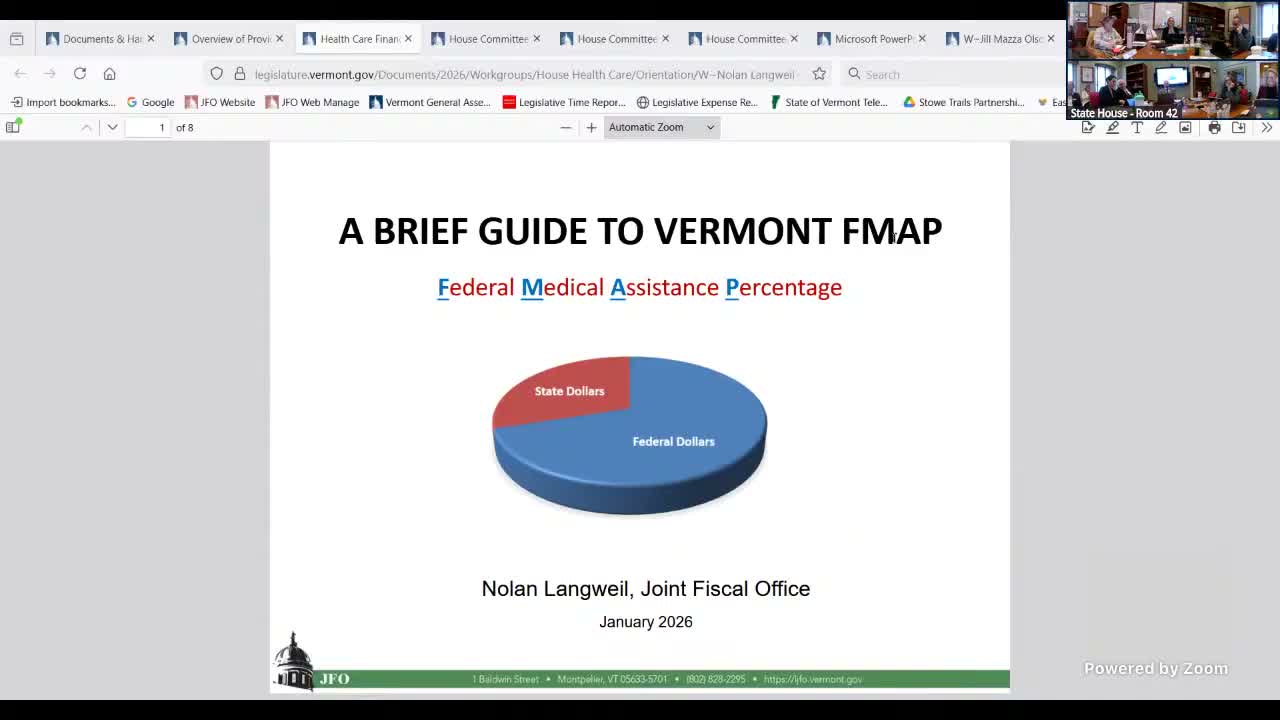
Summary
Nolan Langall (Joint Fiscal Office) gave a plain-language explanation of FMAP (the federal matching rate for Medicaid) and described how states use provider taxes to raise matching funds; he outlined federal rules that require taxes to be broad-based, uniformly applied, and not hold providers harmless.
At a Joint Fiscal Office briefing, Nolan Langall provided a primer on FMAP and how provider taxes function as a financing mechanism for Medicaid.
FMAP stands for federal medical assistance percentage; Langall said it is a federal formula that determines the share of state Medicaid benefit costs paid by the federal government. He explained the broad mechanics: FMAP is calculated by comparing a state's three-year average per-capita personal income with the national average and is announced annually by the federal government. Federal rules cap the match at no less than 50 percent and no more than 83 percent for any state.
Langall used Vermont numbers to illustrate the effect: for federal FY2026 Vermont's FMAP was about 59.01 percent, meaning for many Medicaid programs the federal government pays roughly 62 percent of gross Medicaid spending; Langall said that translates to a gross of about $2.43 for every $1 the state spends (the state's share plus federal match). He stressed the policy implication: reductions in state dollars have an outsized effect because they also reduce federal matching funds.
On provider taxes, Langall explained they are assessments on classes of health-care providers (hospitals, nursing facilities, ambulance services, pharmacies and others) that states can levy under federal rules. Key federal constraints he highlighted were: the tax must be broad-based (cover a class of providers or services), it must be uniformly applied within that class (same rate or fee structure), and it cannot be structured to guarantee providers will be made whole ("no hold-harmless"). Langall gave examples: hospital services taxed on net patient revenue, nursing facilities assessed per bed, and a pharmacy script fee that raises a modest amount annually.
Langall also explained practical considerations that limit expanding provider-tax classes: administrative feasibility (large numbers of small private practices, such as many dental offices, lack audited financials needed for a state to administer a revenue assessment) and revenue yield (some classes would generate little revenue for high administrative cost). He noted federal legislative changes (HR1) would freeze increases and new provider taxes, creating planning challenges for states that rely on provider assessments to draw federal match.
The briefing aimed to give policymakers and stakeholders a grounding in the mechanics and limits of FMAP and provider taxes so they can better evaluate budget and policy responses as federal rules evolve.