Get AI Briefings, Transcripts & Alerts on Local & National Government Meetings — Forever.
Missoula holds public hearing on Unified Development Code and 2045 land use plan; council delays final vote
Loading...
Summary
City staff outlined a multi-year rewrite of Missoula's zoning and development rules designed to increase housing supply and implement the Missoula 2045 land use plan. After hours of public comment both supporting and opposing the changes, the council returned the package to the Land Use & Planning Committee for further amendments.
Missoula city staff presented a comprehensive public hearing on Jan. 12 that explained proposed amendments to the Missoula 2045 land use plan and the adoption of a new Unified Development Code (UDC), a consolidated Title 22 intended to modernize zoning, increase housing choices and align rules with state law.
The presentation, led by Erin Peehan of the Community Planning, Development & Innovation department, traced three years of community engagement and said the UDC is intended to streamline disparate regulations and support compact, walkable development tied to climate and equity goals. "This work has also required sustained commitment from key stakeholders who have leaned in again and again over the last 3 years," Peehan said, framing the package as the product of wide public input.
Staff described major technical changes in the code and map: 22 new zoning districts organized by context (residential, mixed use, special use); use of floor-area ratio and maximum units-per-building to control form; reduced setbacks and minimum lot widths to enable smaller-lot infill; elimination of most neighborhood-character overlays while retaining five historic-resource overlays and an airport hazard overlay; and adjustments to subdivision, variance and appeals procedures to comply with the 2023 Montana Land Use and Planning Act (MCA 76-2-5). Cassie Trippard, planning supervisor, explained the transition provisions and that projects may be permitted under the old or new rules during a transition period to reduce disruption.
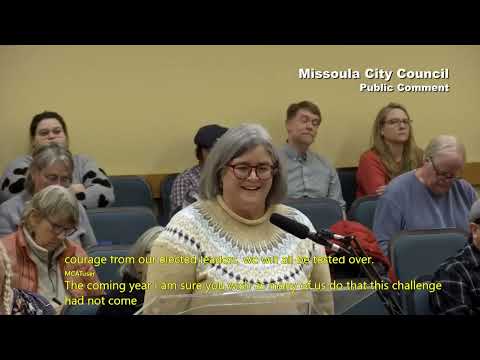
Public comment ran more than three hours and split along several recurring themes. Pro-housing organizations, builders and many residents urged faster adoption and asked the council to adopt technical amendments that staff and the planning commission recommended to reduce landscaping and activity-area requirements so more housing can be built affordably. "Flexibility in building size, height, and mixed use design is not a giveaway to developers — it's how we create more homes that real Missoulians can afford," said Shebu Aarons of Front Step Community Land Trust.
Environmental and neighborhood advocates asked for stronger protections in specific areas. Garden City Harvest highlighted the 10-acre Peace Farm and asked that its zoning reflect its community-food-production role. Fly Valleys Audubon and other conservation speakers urged stronger, science-based riparian buffers than those currently proposed. Several speakers from East Missoula urged changes to the proposed zoning for the Aspire subdivision, saying the parcel lacks transit, sidewalks and other amenities that staff used to justify higher-residential designations.
Speakers also raised technical and implementation questions the council flagged for staff, including the amenity layers that guided mapping, how the mailed notices were distributed to city addresses, and how elimination of parking minimums would interact with ADA-accessible parking requirements. Council members asked staff to supply additional documentation and parcel-level explanations; staff committed to publishing an additional staff memo and said some topics — notably ADA and parking — would be addressed in committee.
No adoption vote was taken that evening. Following public comment and council questions, Councilor Jessica Newcomb moved to return the UDC and related land-use amendments to the Land Use & Planning Committee beginning Jan. 14 for more detailed amendment work; the motion carried without objection. Staff and several commenters said additional amendments and clarifying memos will be posted online prior to the committee meetings; proposed final adoption remains scheduled for Jan. 26.
The hearing produced two clear takeaways for the immediate next steps: council and staff will refine technical thresholds (landscaping, activity areas, mapping methodology and park designations), and the full package will be discussed again in committee before returning to council for final votes. The process is positioned to be iterative: staff indicated the UDC is a living document that can be amended after adoption to address implementation lessons.
For more information and to review mapping and memos, staff directed residents to the project page on the city website and the interactive zoning map that lists amenity layers and parcel-level details. The Land Use & Planning Committee will meet Jan. 14 and again Jan. 21; final council consideration is scheduled for Jan. 26.