Get Full Government Meeting Transcripts, Videos, & Alerts Forever!
Get email alerts on the Zoning Pdd2 topic
No spam. Unsubscribe anytime.
Cottonwood Heights council approves PDD‑2 zoning amendment after debate over tower height
Summary
After a public hearing and sustained resident concern about scale and seismic disclosure, the council approved Ordinance 436 to amend PDD‑2 zoning with a maximum textual height allowance up to 150 feet; the vote was 3–1.
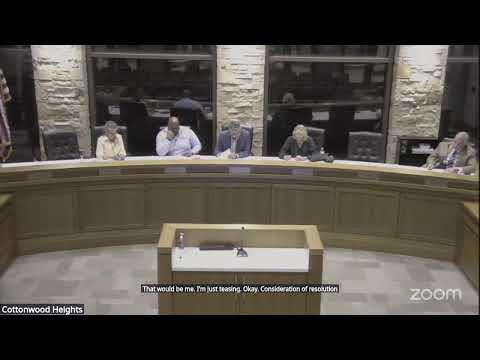
Cottonwood Heights Mayor Mike Wickers and the City Council on April 15 approved Ordinance 436, an amendment to the PDD‑2 zoning text that allows a maximum structural height of up to 150 feet for a proposed condominium at the gravel‑pit redevelopment, after a public hearing that focused on height, neighborhood precedent and seismic disclosure.
The ordinance amendment was the subject of extended public comment and council discussion. Linda Lekman, president of the Canyon Cove homeowners association, told the council the developer’s exhibit understates the visual impact and asked the council to cap the building at 120 feet instead of 150. "I would ask that the requirement be that after this is built, any kind of transaction, be it a lease, a sale, or anything like that, the future inhabitants are informed that the Wasatch Fault is there and what the danger in that area might be," Lekman said.
Another nearby resident, Laurie, said a tall tower would set a precedent for the east bench and the remaining gravel‑pit acres and asked the council to restrict height to be closer to the 35‑foot edge of abutting properties.
Developer representatives from Rockworth Companies said the currently modeled building is roughly 126–127 feet tall and that the PDD measurement (taken from Wasatch Boulevard average grade) creates a difference between “box” height and the apparent built elevation at neighboring streets. Sarah, representing Rockworth, said the 150‑foot maximum would be reduced by slope deductions in practice and that the allowance was intended to enable a financially viable condominium product: "a 150 feet would, at this footprint, allow for about 79 to 80 units," she said. The developer also said they do not intend to market the units primarily as short‑term rentals.
Council members discussed options including delaying the vote to adopt a 120‑foot cap. Council member Sean Newell moved to approve the ordinance; Council member Burrell had moved earlier to delay and consider a 120‑foot limit. The motion to approve Ordinance 436 carried on a recorded vote: Suzanne Hyland — yes; Sean Newell — yes; Burrell — no; Mayor Mike Wickers — yes.
The council and staff also discussed tools to limit short‑term rental conversions in for‑sale condominium projects (buyer‑occupancy restrictions in CC&Rs, financing constraints that limit investor shares, and existing city code that restricts short‑term rentals on units fronting public streets). Staff noted that HOA and deed restrictions are typical enforcement avenues and that the city has limited authority to mandate HOA bylaws outside of code requirements.
Next steps: Ordinance 436 was adopted during the meeting. Project proponents will return in later permitting phases with architectural details and building permits; the Architecture Review Commission will review specific design materials as the project progresses.