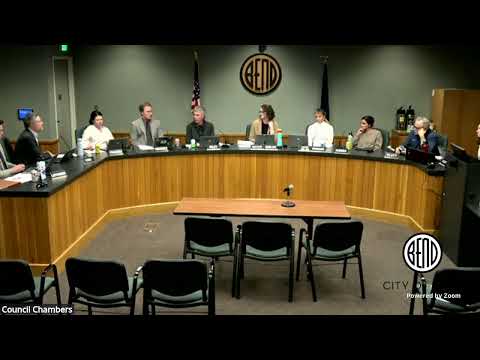
Bend council pauses Flock Safety ALPR use, declines to renew fixed-camera contract amid privacy concerns

City of Bend City Council · January 9, 2026

Get AI-powered insights, summaries, and transcripts

Subscribe
AI-Generated Content: All content on this page was generated by AI to highlight key points from the meeting. For complete details and context, we recommend watching the full video. so we can fix them.

Summary

After hearing both community privacy concerns and police examples of investigative benefits, the City of Bend announced it will not renew its fixed Flock Safety ALPR subscription and directed staff to stop using the cameras for the remainder of the contract while legislative changes are tracked.

Catalina Sanchez Frank of the Latino Community Association opened public comment by warning of rising deportations and the fear those operations have created in local Latine communities. Her organization, which she said provided more than 19,000 direct services last year, urged the city to consider data-privacy risks and to increase support for immigrant-serving services.

City staff and the police department briefed council on the fixed ALPR pilot. City Manager King said the contract (approved in May 2025) covered four fixed automatic license-plate reader cameras — two at each end of Highway 97 — paid primarily with grant funds for a one-year evaluation. Captain Brian Beekman outlined concrete outcomes since deployment, saying the system alerted officers to three stolen vehicles that were recovered and "at least, my estimation, $3,540,000 dollars in recovered stolen property," helped locate a missing endangered elderly person, and produced an alert that led to arrest of a suspect wanted in a near-fatal stabbing.

At the same time, community members and privacy professionals said vendor contract language and U.S. law create risks. An online commenter identified as Chris, a local privacy professional, cited Electronic Frontier Foundation reporting and warned that U.S. companies can be compelled to provide data under national-security authorities. Other in-person speakers recited contract clauses they said allow Flock to keep and reuse anonymized data, share footage based on "good faith" judgments, and limit city ability to control third-party disclosures.

Councilors discussed those contract provisions and state law limits. Staff pointed to provisions requiring written notice to the customer if legally compelled to disclose data, but city counsel noted some contract language using "good faith" judgments that could be legally ambiguous. Given those concerns and ongoing legislative work on ALPR governance, council agreed the city will not renew the Flock Safety subscription and directed staff to cease using the cameras for operational purposes during the remainder of the contract term; the city will continue to pay under the existing contract while exploring policy and procurement alternatives.

Mayor Keebler asked staff to return with updates as state and federal rules evolve and as the city pursues procurement safeguards, data-retention limits, and vendor contract protections. Several councilors and public commenters urged pursuit of locally managed or auditable alternatives to provide law-enforcement benefits while preserving transparency and community control.

The council’s decision is a direction to staff rather than a separate ordinance; next steps include tracking proposed legislation, reviewing contract language across vendors, and reporting back to council on options for oversight and alternative systems.