
Villa Rica council unanimously asks state to restore pre‑2024 city‑manager appointment process after heated debate
Get AI-powered insights, summaries, and transcripts
Subscribe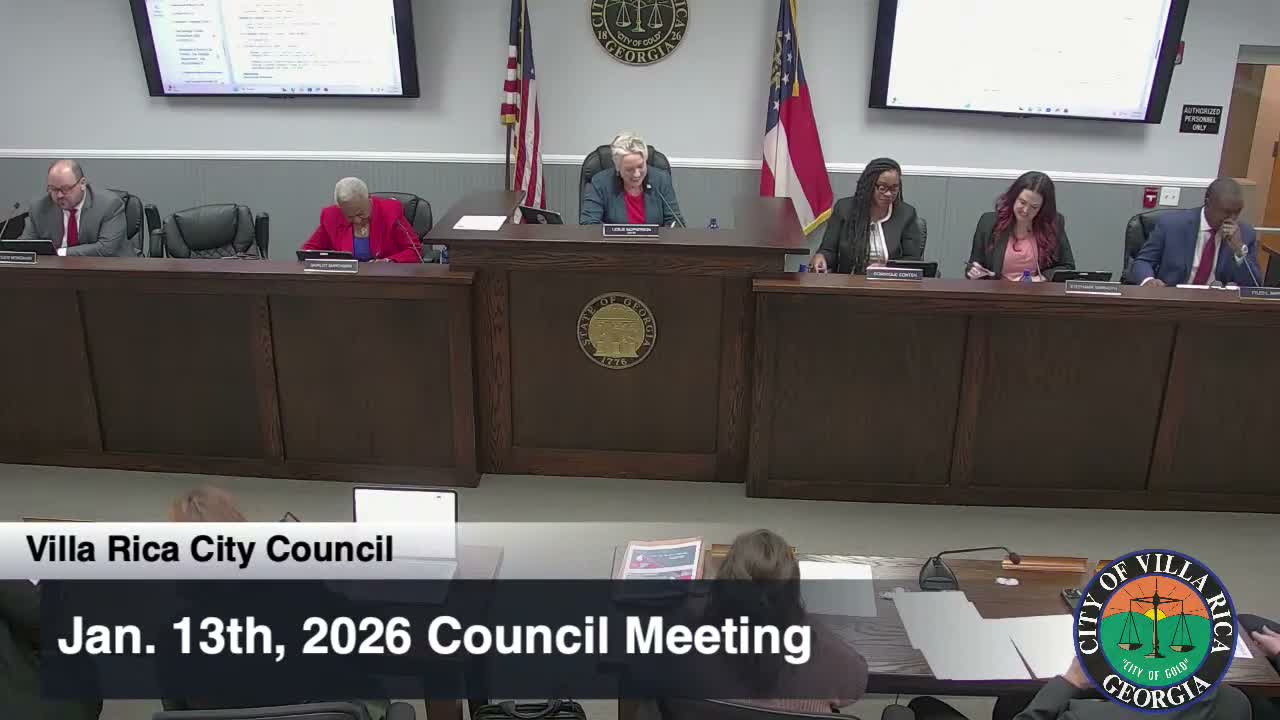
Summary
After an extended discussion over the 2024 charter changes and a contentious hiring episode, the Villa Rica City Council unanimously adopted a resolution asking the state legislative delegation to restore earlier language so the mayor and council participate in selecting a city manager.
The Villa Rica City Council on Jan. 13 unanimously approved a resolution asking the city’s state legislative delegation to revert portions of a 2024 charter amendment so the mayor and council jointly participate in selecting a city manager.
Supporters said the change would return local control to the governing body and clarify the mayor’s role in hiring. Attorney David Mecklen, who helped draft the proposed language, told the council his amendment simply makes explicit what the charter already implies: 'the mayor and the council' participate in the selection and termination of a city manager. Mecklen said he added the wording to avoid confusion created by differing uses of 'council' and 'mayor' elsewhere in the charter.
The debate turned personal and procedural as the mayor recounted a fraught 2023–24 period in which a prior city manager took actions that, the mayor said, violated hiring policies and federal Hatch Act guidance and prompted legal and staffing turmoil. The mayor described paying for legal counsel and the difficulty of governing while a manager ‘would not meet with me’ after the mayor‑elect took office; in her remarks she said, 'I had to hire attorneys... I've paid a lot more out in money than I will ever make in this job.'
Council members pressed the city attorney on technical questions about where the charter uses 'council' versus 'mayor' and whether adopting the resolution would create internal contradictions in the document. Some council members argued that the 2024 change 'is not working' and that returning to the earlier language is necessary to prevent similar governance breakdowns.
After extended discussion, the council voted to adopt the version of the resolution it preferred and to forward it to the legislative delegation. Because the mayor indicated she might not be comfortable signing a resolution she opposed, the council also unanimously authorized the mayor pro tem to sign the document if the mayor declines. Attorney Mecklen noted the resolution is the council's formal expression to the legislature; the legislature then decides whether and how to act.
What happens next: the council's unanimous resolution will be delivered to the city’s state legislative delegation for consideration. Any change to the city charter requires action by the state legislature; the council’s resolution expresses local intent and asks the delegation to sponsor or support language that restores the prior appointment framework.
• Key voices: Attorney David Mecklen presented the draft language and legal rationale; the mayor provided a detailed account of the hiring conflicts that prompted the push for the change.