Lifetime Citizen Portal Access — AI Briefings, Alerts & Unlimited Follows
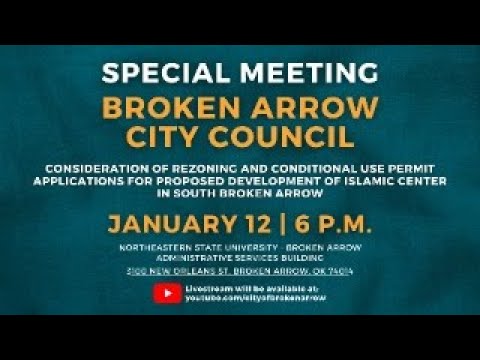
Broken Arrow council denies rezoning for proposed Islamic center after hours of public comment
Loading...
Summary
After a lengthy public hearing marked by heated debate over traffic, floodplain and religious freedom, the Broken Arrow City Council voted 4–1 to deny a rezoning request and conditional-use approval for a planned Islamic center near South Olive Avenue; staff had recommended approval.
Broken Arrow — After more than three hours of public testimony, the Broken Arrow City Council on Wednesday voted 4–1 to deny a rezoning request (BAZ-002469-2025) and associated conditional-use permit (SP-2526-2025) for a proposed Islamic center on land east of South Olive Avenue near the Creek Turnpike.
City staff and the planning commission recommended approval. Rocky Hinkle, community development director, said the 15-acre site has a comprehensive-plan designation (Level 6) that allows higher-intensity uses, and that the planning commission recommended rezoning by a 4–1 vote and the conditional-use permit by 3–2 with a condition restricting outdoor speakers.
The applicant’s agent, Masood Kesem, framed the project as a “low-impact community-oriented use” and urged the council to apply zoning rules consistently to faith-based institutions. “This is not a commercial operation,” Kesem said, adding the mosque would comply with traffic, parking and safety requirements.
Engineers for the applicant, represented by Nicole Watts of Wallace Design, described site constraints including floodplain and a jurisdictional stream. Watts said the zoning code’s parking standard (1 space per 4 seats, or 1 per 100 sq. ft.) would require about 150 spaces for the first phases of the proposal; earlier conceptual layouts showed larger parking counts that the applicant later reduced.
Hundreds of residents spoke during a long public-comment period. Supporters—many of them Muslim residents and civic leaders—emphasized constitutional protections and community service plans, including a proposed food pantry and medical screenings. “We are asking for equal treatment under the same laws and standards that apply to every other faith community in Broken Arrow,” one speaker said.
Opponents centered their remarks on traffic, stormwater, floodplain impact and the city’s 2019 comprehensive plan. Multiple speakers representing nearby businesses and homeowners warned that Olive Street is a two-lane road not slated for widening for roughly a decade, that culverts and downstream channels are already strained, and that septic/leach-field plans would present environmental and public-health risks unless resolved.
Several speakers raised allegations about the property owner’s national affiliations. Linda Russell, a resident, cited historical reports and public statements tying the North American Islamic Trust (NAIT) and other entities to the Muslim Brotherhood and urged caution; the applicant’s representative responded in the hearing that NAIT’s role is custodial and asset-protective and that local mosque boards run day-to-day programs. The applicant spokeswoman said the organization would comply with any lawful requirement to sever such ties if state or federal authorities demanded it.
Council discussion focused on whether the project reasonably complied with the comprehensive plan and whether the outstanding technical issues—traffic capacity, stormwater mitigation and wastewater management—had been sufficiently addressed. One council member moved to deny the zoning change; a seconded motion carried on a roll-call vote: Councilor Pickle — Yes; Councilor Green — Yes; Councilor Ford — Yes; Vice Mayor Parks — No; Mayor Wimpey — Yes. The motion denied the requested rezoning.
The denial halts the applicant’s effort at this location; the record indicates the applicant may still pursue engineering studies, alternative sites, or future applications, but the council took no additional direction or referral at the meeting’s close. The meeting adjourned immediately after the vote.
What’s next: The council’s written minutes and any formal denial resolution will provide the official legal record and the precise motion language. If the applicant chooses to refile or appeal, state and federal laws—particularly religious-land-use protections—could shape the process and timing.