Get email alerts on the School Safety Mou topic
No spam. Unsubscribe anytime.
ACP advances school-safety recommendations, asks county to provide CEO program satisfaction data
Summary
The Advisory Commission on Policing voted to advance most recommendations from its school-safety subcommittee — including auditing the MOU between schools and police — and to recraft one recommendation to request school-system data on community and staff views of the Community Engagement Officer (CEO) program.
The Advisory Commission on Policing on Jan. 20 voted to advance key recommendations from its school-safety subcommittee and instructed staff to ask Montgomery County Public Schools for data on how community members and staff view the county’s Community Engagement Officer (CEO) program.
The commission moved, and members approved by voice vote, to pursue three of the subcommittee’s recommendations immediately — auditing the memorandum of understanding (MOU) that governs police–school interactions, clarifying who maintains and validates the related data, and engaging district leadership to discuss improvements. Commissioners also agreed to revise the subcommittee’s third recommendation to request existing survey and satisfaction data about the CEO program rather than creating a standalone new survey.
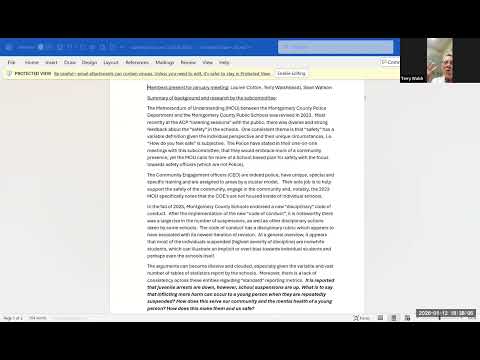
Terry, who presented the school-subcommittee memo, summarized listening sessions and local data analysis and said Montgomery County’s 2025 disciplinary rubric has coincided with more student suspensions and that those suspended appear disproportionately non-white. "We also reviewed much of the data… it was brought out that in 2025 Montgomery County has changed their disciplinary rubric… many more students are being suspended… and the students that are being suspended, they are non white," she said, urging an audit of the MOU and clearer data definitions.
Commissioners questioned the relationship between declining juvenile arrests and rising suspensions and whether suspensions are being used as an alternative to police involvement. "A suspension is adversely impacting a student's academic performance, as well as self-concept," Eva said, citing longitudinal research showing associations between suspensions and later negative outcomes.
Members emphasized process limits: Francisco noted the commission’s work carries more weight if it focuses on the MOU and the police role rather than broader school-policy decisions best handled by the Board of Education or PTAs. Several members suggested the commission should seek existing climate-survey data first and, where feasible, suggest adding targeted questions rather than launching an entirely new countywide instrument.
The commission passed the motion to advance recommendations 1, 2 and 4 and then approved a separate motion to recraft recommendation 3 to read that the ACP ask the school system to provide data about community and staff satisfaction with the CEO program. Sheree moved the recraft; Terry seconded. The recraft was adopted by voice vote with no opposition recorded.
Next steps recorded in the meeting: ACP staff will research existing climate surveys to determine whether those tools and timelines can be used to capture attitudes about police presence and the CEO program, and the commission will invite superintendent-level representatives and, where appropriate, PTA representatives to future discussions about the MOU and implementation details.
The motion to advance the recommendations and the motion to recraft recommendation 3 were recorded as passed by voice vote; individual roll-call tallies were not read aloud.
AI generated
The text on this page is AI generated. Summaries, highlights, analysis, and video transcripts are all produced from the original source material.
AI can make mistakes, so if you spot one, and we will fix it for everyone.
Note: the source content is unaltered by us. Any content source we link to, be it a video, an audio recording, or a document, is presented exactly as its publisher released it. That publisher is usually a government body, sometimes an individual official or another organisation.