
How value‑added earnings, liabilities and Pell restoration will work under proposed Workforce Pell rules
Get AI-powered insights, summaries, and transcripts
Sign Up Free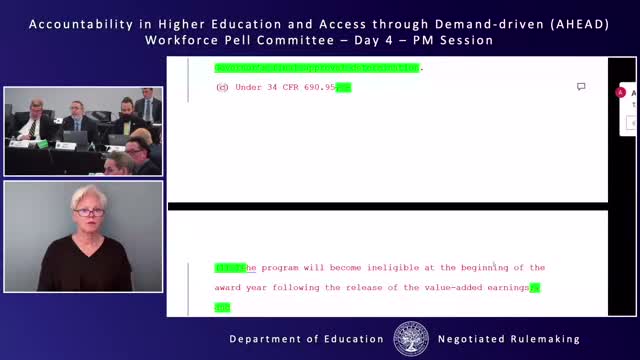
Summary
Department negotiators clarified that value‑added earnings will set award‑year eligibility, that programs found ineligible may trigger liabilities for Pell Grant amounts disbursed during that award year, and that repayment restores students' lifetime Pell eligibility units in the COD system.
Department of Education negotiators used examples to explain how value‑added earnings (VAE) and award‑year timing determine eligibility and institutional liability under the proposed Workforce Pell rules.
The Department said VAE calculations will be released and applied to the next award year; as a result, a program that fails to meet the VAE threshold would become ineligible at the beginning of that award year. Department staff stated: "The Secretary will assess a liability for amounts paid to the institution for the program during the award year for which the value added earnings were calculated and may collect any such liability from the institution." Negotiators pressed the Department to be precise: Jeff asked whether the regulation meant funds disbursed to students or funds paid to institutions; the Department agreed to change the draft wording to refer to "Pell Grant amounts disbursed," covering both institutional payments and student credit/refund disbursements.
On whether liabilities result in restored student eligibility, Department staff explained operational mechanics: "Anytime a liability is assessed and Pell Grant funds are repaid to the department, LEUs are restored automatically by virtue of the funds being returned in the common origination and disbursement system." Staff said they will provide examples and timelines in subregulatory guidance to help institutions and states understand when liabilities will be assessed and how students will be made whole.
Negotiators asked how the approach differs from loss of eligibility tied to completion and placement rate determinations, which operate on a different timeline and do not create automatic retroactive liabilities for entire award years. Department staff described distinctions in timing and the different operational implications for institutions.
The Department committed to wording changes and to circulate revised regulatory and operational language ahead of a planned consensus vote. No formal liability determinations or rule adoptions occurred during the session; negotiators requested explicit draft language describing how liabilities will be calculated and enforced and how student Pell restoration will be handled in practice.