Department of Education negotiators refine Workforce Pell rules on eligibility, appeals and liabilities ahead of consensus vote
Loading...
Summary
Negotiators and Department staff advanced proposed Workforce Pell regulatory text that tightens how programs lose and regain eligibility, clarifies state appeal roles and timing, and spells out liability and Pell restoration mechanisms tied to value‑added earnings and placement metrics.
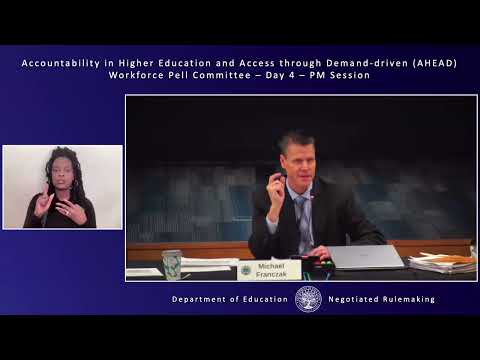
The U.S. Department of Education and negotiators spent the afternoon reviewing proposed regulations for the Workforce Pell pilot program, focusing on exceptions for incarcerated and disabled students, the timing of state appeals, and how the Department will assess liabilities if programs lose eligibility.
Department staff walked participants through revisions to 34 CFR sections including 690.96 and related provisions, saying the language now focuses on a governor’s action to withdraw approval and clarifies that the Secretary “will not make such a determination while the program’s eligibility, approval, or reported completion rate or job placement rate is in an appeal status or awaiting the Governor’s final approval determination.” The Department also signaled it will operationalize rules about timing and submission to limit abuse of appeals processes.
Negotiators raised several concerns. Tamar warned that state appeal processes vary and can be used to “run out the clock” on loss of eligibility; the Department acknowledged the risk but said it lacks regulatory authority to set state timelines and will instead adopt subregulatory guidance and firm operational rules to address timing and documentation. Tamar also suggested potential accountability measures such as financial liability for amounts disbursed during pending appeals and restoration of Pell eligibility to affected students; Department staff said they are open to exploring parameters with operational teams.
On financial consequences, the Department explained how value‑added earnings (VAE) will feed into award‑year eligibility. Staff said a program would become ineligible at the beginning of the award year after VAE are released and that “the Secretary will assess a liability for amounts paid to the institution for the program during the award year for which the value added earnings were calculated and may collect any such liability from the institution.” Negotiators pressed for clearer wording; the Department agreed to revise text to specify “Pell Grant amounts disbursed” and confirmed that when liabilities are repaid, lifetime eligibility units are restored automatically in the common origination and disbursement (COD) system.
Participants also discussed several technical and equity issues: whether completers who immediately enroll in subsequent programs should be excluded from placement denominators (an issue Eric tied to statutory language), accommodations for programs serving students with disabilities whose placement rates may be lower, the fit of prison education programs in Workforce Pell metrics, and how states should handle small‑N calculations for placement rates. On incarceration, negotiators proposed — and the Department accepted in principle — using the WIOA‑style phrasing “becomes incarcerated” as an involuntary exclusion that would not be abused to manipulate rates.
The session included a series of short caucuses (employers, state higher ed, legal aid, veterans, accrediting agencies and institution negotiators) to narrow outstanding issues; Department and negotiators said they would reconvene tomorrow for a planned full consensus vote on the Workforce Pell package. Several constituencies signaled they may file further changes overnight; alternates were named for tomorrow’s session.
The Department did not take a formal consensus vote today. Negotiators asked the Department to provide draft operational language clarifying how appeals will be handled and how states must submit final determinations; the Department agreed to continue discussions and said it expects to return with revised language before tomorrow's consensus check.