Get Full Government Meeting Transcripts, Videos, & Alerts Forever!
Get email alerts on the Land Use Development topic
No spam. Unsubscribe anytime.
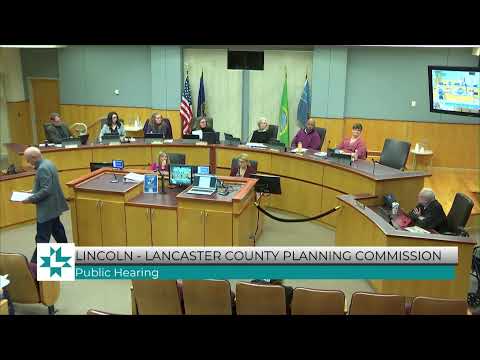
Planning commissioners continue hearing on Kruger Development’s PUD at 70th and Yankee Hill after neighbors press traffic, tree and sidewalk concerns
Summary
Kruger Development asked to annex and rezone land at South 70th and Yankee Hill for a PUD that would apply H-4 commercial regulations over an R-3 base; neighbors raised safety, tree-removal and sidewalk-waiver concerns and the commission voted 8–0 to continue the public hearing for two weeks so staff and applicant can address outstanding waivers and technical memos.
Kruger Development’s proposal to annex land at South 70th and Yankee Hill and apply a Planned Unit Development overlay drew sustained questions from planning commissioners and strong opposition from nearby homeowners on Thursday, and the commission voted 8–0 to continue the public hearing for two weeks at the applicant’s request.
Planning staff opened the public hearing by describing the mechanics of the request: the parcel would be annexed and its underlying zoning designated R-3 while portions of the PUD would follow H-4 commercial regulations, triggering a comprehensive-plan amendment and a change to the property’s growth tier. Staff also said coordination with the city’s Land-Use and Transportation unit (LTU) and watershed management remains ongoing.
Christina Malgoza of Kruger Development presented visuals and design goals, saying the proposal is a “continuation of our Woodlands development” with smaller, “transitional” commercial buildings intended to be occupied by small businesses such as a pediatric dentist, veterinarian or other neighborhood-serving tenants. The applicant confirmed that existing trees and foliage on parts of the site would be removed during development but said retaining walls, elevation changes and landscaping would be used to buffer adjacent homes.
Neighbors pressed several technical and quality-of-life concerns. Longtime resident Claire Bridal said the project would “erase a landscape that has defined our homes and our lives for generations,” warned the developer would remove trees and a spring that support willow habitat, and urged rejection of the annexation. Matthew Green and other nearby residents criticized multiple requested waivers — including reduced setbacks and sidewalks — and said 70th Street is already congested and unsafe for children walking to nearby schools.
State representative Carolyn Bosn, speaking in a personal capacity, echoed residents’ safety concerns and highlighted that the planning department recommends denying the developer’s requested sidewalk waiver. In response, city planning staff said the most recent traffic count for 70th Street (2024) was about 9,000 trips and that widening 70th farther south is not currently scheduled in the CIP because of limited funds; staff suggested the Lincoln on the Move fund could accelerate improvements if funded.
On technical specifics, engineer Rick Onnam (CNA Consulting) told commissioners that the proposed retaining wall would vary in height — from roughly 5–6 feet in some locations up to about 14 feet in others — and that the wall footprint would leave room for shrubs but likely not mature trees in many spots. The applicant also said it will seek a waiver of minimum flood-corridor requirements (Section 27-53) because the drainage area near the site just exceeds a 40-acre threshold; the applicant said it needs time to coordinate with watershed management and properly advertise that waiver.
Applicant counsel asked the commission for a two-week continuance so the developer and staff can resolve outstanding items — including the new flood-corridor waiver language — and provide an updated staff memo. Planning staff confirmed the city’s practice that members of the public who testified at the initial hearing typically do not testify again at the continued hearing unless substantive new information emerges, though they may submit written comments.
Commissioner Campbell moved to continue the public hearing for two weeks on Annexation 25008 and the associated zoning and comprehensive-plan items; Commissioner Evans seconded. The motion passed 8–0. The continuance covers the three linked applications and was framed by commissioners as an opportunity to receive the traffic study memo, flood-corridor analyses and other clarifications before the next hearing.
What’s next: the planning commission will reconvene the public hearing in two weeks. Staff said they will circulate any updated memos and that residents who cannot return may submit written comments in the interim.