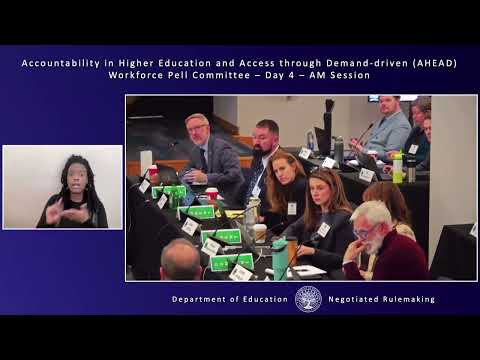
Department extends transitional window for placement metrics; negotiators clash over excluding students who pursue further education
Loading...
Summary
The Department added an extra year to the transitional period for completion and placement rate calculations but declined to add a 'further education' exclusion; negotiators argued about statutory interpretation and incentives for institutions.
The Department presented changes to placement and completion rate rules that extend a transitional implementation period by one year, acknowledging that states will need extra time to collect occupation‑specific data. "We feel that it was reasonable to give that extra year," Federal negotiator Dave Musser said, and negotiators from several constituencies responded positively to the extra runway.
A sustained dispute followed over whether students who go on to further postsecondary education should be excluded from placement calculations. Negotiator Aaron urged the Department to include a further‑education exclusion, arguing that Workforce Pell programs are statutorily designed as "pathway" programs and that counting students who continue schooling as non‑placed would unfairly penalize institutions and disincentivize the pathway design.
OGC counsel Jake Guallo countered that the statute and the placement metric focus on employment outcomes and that there is limited statutory authority to treat continued enrollment as equivalent to job placement. "I think it is a mandate that this can lead to further educational attainment, but the job placement rate is distinct," Guallo said. Negotiators and Department staff discussed appeal and mitigation processes that might allow qualitative evidence (for example, program design demonstrating stackability) to temper quantitative placement calculations.
Department staff also proposed requiring institutions to report published tuition annually so the Secretary can compare tuition to calculated value‑added earnings, and they listed limited exclusions from placement/completion rates (student death, onset of medical condition preventing employment, or being called to active military service). The Department declined to add an exclusion for students who enroll in further education or for incarceration as a classwide exclusion, saying Congress intended placement metrics to measure whether programs lead to employment.
Next steps: negotiators asked the Department to revisit legal language and consider clarifying appeal procedures and mitigation options; discussion of remaining technical language was scheduled to continue after lunch.