
Education Department proposes governors' bilateral pacts for cross‑state Workforce Pell online enrollment
Get AI-powered insights, summaries, and transcripts
Subscribe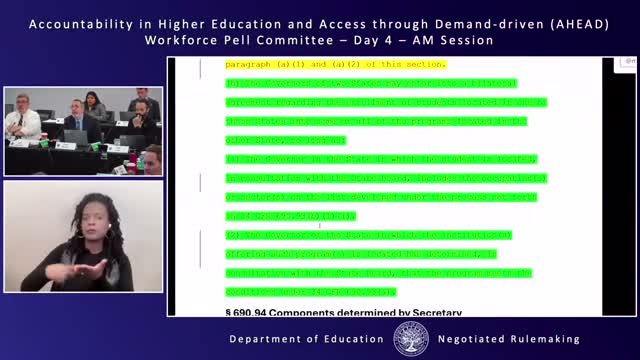
Summary
The Department proposed new language requiring governors of two states to enter bilateral agreements before Workforce Pell funds can be used by students who live in one state to enroll fully online in programs based in another; negotiators debated scope, timing, and data‑sharing implications.
Federal negotiator Dave Musser presented new regulatory language to govern cross‑state enrollment for Workforce Pell programs, telling the committee the amendment would allow "the governors of 2 states [to] enter into a bilateral agreement regarding the enrollment of students located in 1 of those states into some or all of the programs located in the other state." Musser said the bilateral pact would require both the student'state and the institution'state to list the occupation or sector as high‑need under 34 CFR 690.93.b.1 and to certify the statutory conditions for an eligible workforce program.
Musser and departmental legal staff said the change aims to ensure programs paid with Workforce Pell funds address each student's state economic needs. "Absent the language," Musser warned, students could be enrolled in programs that meet the home institution's regional needs but not the student's state's workforce needs. Department staff also told negotiators that without the bilateral framework a student enrolled fully online might be ineligible to receive Pell funds for that program.
Negotiators expressed mixed reactions. Rachel Stevens Parker asked whether the bilateral agreement would be required before a student in State B could receive grants for an online program located in State A; Musser replied that the language is intended to make that requirement for fully online enrollments. Several negotiators, including Eric Acheson and David Kefafian, cautioned that requiring governors' agreements risks creating new administrative hurdles and timing delays for students searching for online programs.
Department attorneys (OGC) and policy staff explained the choice of a bilateral rather than multilateral model, saying bilateral agreements better fit CFR constructs for sovereign agreements and preserve guardrails against nationwide proliferation of eligibility without state review. Department staff also said governors can chain bilateral agreements (state A with state B, B with C) but that multilateral compacts could create data sharing and decertification risks.
The Department acknowledged practical concerns and agreed to consider clarifying language about data sharing and about whether the Department would collect or publish bilateral agreements centrally for providers' access. Negotiators urged that the Department add preamble language or regulatory clarifications explaining how governors should manage timelines and data transfers when programs cross state lines.
Next steps: the Department said it would review the legal wording, consider data‑sharing language for inclusion in the preamble, and continue discussion after lunch.