Get Full Government Meeting Transcripts, Videos, & Alerts Forever!
Get email alerts on the Workforce Pell topic
No spam. Unsubscribe anytime.
Education negotiators outline likely Workforce Pell program categories and clash over nonfederal aid rules
Summary
Department of Education staff told negotiators that health‑related, career‑technical, commercial vehicle/operations and business/clerical programs are the most likely initial categories for Workforce Pell Grants, and estimated 'several hundred to a few thousand' potentially eligible programs. Negotiators debated timing and scope of institutional duties when students receive nonfederal grants and how apprenticeship credentials will be treated.
Cody Christiansen of the U.S. Department of Education told a federal negotiating committee that the department expects four broad categories of programs to be most likely eligible for the new Workforce Pell Grant: health‑related programs (for example, nursing assistant and phlebotomy), career and technical education (welding, HVAC, electrical), commercial vehicle and vehicle operations (including commercial driver’s license training) and business/clerical/education programs (such as childcare and accounting technology). "There are 4 buckets of types of programs that the department expects to be, likely eligible to receive, workforce Pell grants," Christiansen said during a presentation to negotiators.
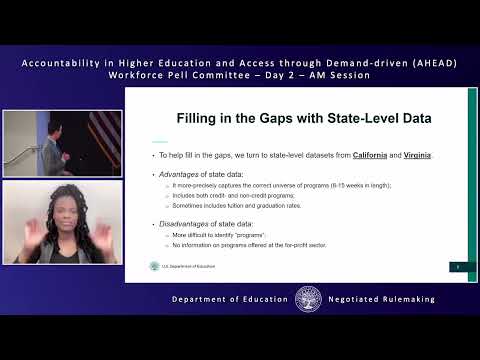
Christiansen described the central data challenge: federal IPEDS data capture the wrong universe for many short‑term and noncredit programs and therefore undercount or misclassify many of the programs Workforce Pell is intended to reach. To fill gaps, ED staff presented state datasets from California and Virginia (including Virginia's Fast Forward program), which provide greater visibility into noncredit programs, tuition and credentialing information, and—in Virginia's case—completion and credential rates. Christiansen characterized the program‑count estimate as an upper bound: "It could be as few as several 100, to as many as, a few thousand," and warned the final number will shrink once all statutory eligibility criteria are applied.
Negotiators pressed ED staff on multiple operational details during an extended question‑and‑answer period. Preston Cooper and others asked whether federal data can disaggregate programs under 12 weeks; Christiansen said IPEDS cannot separate 1–7 week programs from the broader short‑term category in the federal dataset. Panelists also discussed stackability and articulation between short‑term credentials and longer degree programs; ED said state data do not reliably capture articulation agreements and agreed to follow up.
A primary point of contention was ED's proposed treatment of nonfederal grant or scholarship assistance and the department's interpretation of the statutory duty for institutions. ED described a narrowed operational approach: if an institution becomes aware (before the final disbursement of the student's Pell for the award year) that a student "has or will receive" nonfederal grant or scholarship assistance that equals or exceeds the student's cost of attendance, the institution must take one of two actions—reduce the nonfederal assistance so it no longer equals or exceeds cost of attendance, or return all of the student's Pell funds and cancel future disbursements for that award year. "If the school becomes aware that this is going to occur before the final disbursement of the student's Pell grama for the award year, then they need to take action," ED staff said.
Negotiators from student and veterans' constituencies urged caution with that "must" formulation. Matthew Feeham, senior policy adviser for Veterans Education Project, told the committee that servicemembers and veterans worry institutions could shift liability to individuals and potentially pursue collections: "The Department's proposed language ... would be encapsulated by the subpart B that's been proposed," Feeham said during a caucus report, but he urged additional guidance for veterans and service members to avoid unintended harms. Other negotiators asked ED to consider safe harbors, tolerances or explicit operational timeframes to limit the risk of overpayment enforcement falling on students; ED said its authority to adopt tolerances is constrained by statute but invited written proposals and said it will consider subregulatory guidance on implementation.
ED legal staff defended the department's reading of the statute. Department counsel noted the statute uses a command term ("shall"), which constrains regulatory interpretation and motivated the department's rule drafting. Officials also raised a separate concern: excluding expected but not yet disbursed aid would allow institutions to "game" eligibility by holding grants until after an award year to preserve Pell disbursements, so ED said it needs some mechanism to account for aid that is certain and expected prior to disbursement.
Negotiators also sought clarity on apprenticeships and the meaning of a "recognized postsecondary credential." ED distinguished the Higher Education Act's requirement that an institution confer a credential at the end of required coursework from workforce/WIOA language about industry‑recognized credentials and related instruction. ED said related technical instruction that is part of a registered apprenticeship can qualify if, when taken together, the instruction leads to a recognized postsecondary credential consistent with HEA definitions, and the institution confers a credential at the completion of the instructional component. Department of Labor staff emphasized the need for alignment with existing apprenticeship standards and state registration processes.
ED summarized proposals it has accepted (for example, clarifying that emergency assistance is excluded from the definition of other financial assistance) and items it cannot adopt because of statutory limits (for example, removing the statutory phrase "accepted for enrollment"). The committee scheduled a caucus on exceptions and repayment procedures, which convened in a closed session and reported back; negotiators then recessed for lunch with plans to continue later in the day.
The session left several operational questions open for follow up: whether ED can or will specify a precise deadline for institutional adjustments, how states will implement governor approval processes and competency alignment, and what interoperable data might be required to make program lists and outcomes visible. ED asked negotiators for written proposals on tolerances, safe harbors and data interoperability and said it will continue to review the large set of written proposals it received.