Lifetime Citizen Portal Access — AI Briefings, Alerts & Unlimited Follows
Oxnard staff details nine sticking points, recommends two‑year pilot for nonprofit managing PAC meeting rooms
Loading...
Summary
Deputy City Manager Katie Casey told a City committee that negotiations with the OPAC nonprofit have progressed but that nine issues — from liquor licensing and security to revenue splits, concessions, booking systems, naming rights, compliance, repairs and contract length — need committee direction before contracts go to City Council.
Deputy City Manager Katie Casey briefed the Community Services, Public Safety, Housing and Economic Development Committee on negotiations with the OPAC nonprofit over operations of meeting rooms at the Oxnard Performing Arts and Convention Center (the PAC) and laid out nine outstanding issues staff says must be resolved before final contracts are presented to City Council.
Casey said the PAC is a city‑owned facility built in 1968 that faces decades of deferred maintenance. "A 2024 City Facilities Assessment identified more than $9,300,000 in repairs," she said, and the city's mid‑cycle capital improvement update included a rough order of magnitude of about $22,000,000 for seismic retrofit work, leaving total short‑ and long‑term needs that staff estimates will exceed $30,000,000.
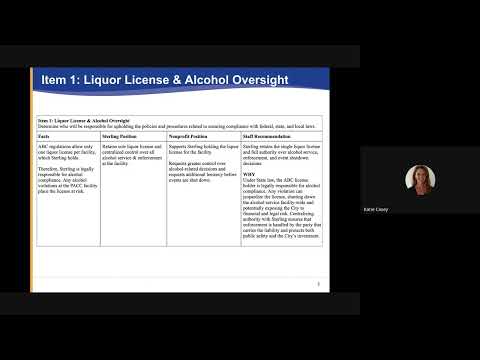
Because Sterling holds the facility's single Alcoholic Beverage Control (ABC) license, staff recommends Sterling retain sole control of liquor licensing, enforcement and event‑shutdown authority. "Under state law, the ABC license holder is legally responsible for alcohol compliance," Casey said, arguing centralized control protects the license and reduces city liability.
Casey told the committee staff documented security incidents at several nonprofit‑managed events, including fights, injuries, underage drinking and event shutdowns. Staff recommends centralized security under Sterling for both alcohol and non‑alcohol events to ensure consistent enforcement and reduce compliance gaps.
On finances, staff recommended a 60/40 revenue split in favor of the City for nonprofit‑booked meeting rooms to cover roughly 10 hours per week of added oversight and management time. Casey said that, based on fiscal year 2025 figures, the additional 10 percentage points would generate about $37,000 annually that can be applied to deferred maintenance.
Staff also proposed requiring the nonprofit to pay 15% of gross food‑and‑beverage margin for meeting‑room events and to require all vendors to hold a City of Oxnard business license and carry appropriate insurance. The nonprofit's counterproposal objects to a 15% concession charge as nonstandard for nonprofit operators and said it would add administrative burden.
To improve transparency and recordkeeping, Casey recommended the City require meeting‑room bookings be made through the City‑controlled Facilitron platform rather than allowing a parallel nonprofit booking system. She said the nonprofit offered to pay for Facilitron subject to city approval but staff prefers direct city control of booking records and compliance data.
Staff also raised a trademark concern: the nonprofit has registered use of the acronym "OPAC" and staff recommended contract language to ensure a third party cannot control the name of a city asset or restrict future use.
On compliance, Casey proposed a tiered enforcement framework with clear performance standards, cure periods for correctable violations, immediate termination authority for serious safety or legal breaches, and 30‑day termination for convenience. For capital repairs, staff reiterated that major building improvements should be funded through the PAC Fund and the City's Capital Improvement Program; staff does not recommend reimbursing the nonprofit for extraordinary repairs.
As a risk‑management measure, staff recommended a two‑year pilot contract for the nonprofit with a one‑year review that would track metrics such as security incidents, Facilitron compliance and meeting‑room revenue performance.
Casey asked the committee to provide direction on the nine items so staff can incorporate feedback, return the Sterling contract to committee at a later date and present both agreements to City Council for formal consideration. The committee is set to workshop these items at its Jan. 27 meeting.