Get email alerts on the Student Programs Aac topic
No spam. Unsubscribe anytime.
Students and specialists highlight career programs and demonstrate AAC tools
Summary
Student representatives described career-focused events, survey results on postgraduation plans and bullying concerns, and speech-language staff demonstrated augmentative and alternative communication devices used by about 40 students across the district.
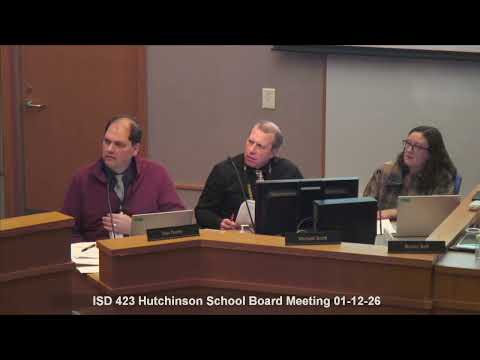
A student representative told the board the Blue Collar Tour will be held at Hutchinson High School on Jan. 22 from 9 a.m. to noon, describing it as an opportunity for the public to see hands-on career programs. Student presenters also summarized survey responses: among 75 juniors who replied, 67% plan to attend college, 12% plan to enter the workforce, 15% plan trade/apprenticeship and 4% plan military service; among 40 responding seniors, 71% plan college, 19% workforce and 10% trade school. The students reported about 20 total concerns collected and roughly 7–8 specifically citing bullying.
Speech-language pathologists presented the district's augmentative and alternative communication (AAC) work, circulating examples and explaining the spectrum of supports. Presenters described "no-tech" strategies (gestures and pointing), low‑tech core boards and mid‑tech switches, up to high‑tech iPad-based communication apps that can carry more than one hundred symbols and be customized with language switching, voices and skin tone representation. District staff said roughly 40 students currently use AAC devices; some use them temporarily as a bridge to speech, others part-time or long-term depending on individual needs.
Presenters stressed family training and early intervention. A classroom example noted a two- to three-year-old who, after months with a device, demonstrated knowledge of body parts and progressed toward verbal speech, a result staff described as evidence of AAC's practical impact.
The board did not take action on these presentations; they were informational updates intended to inform curriculum, special education and family communication planning.
AI generated
The text on this page is AI generated. Summaries, highlights, analysis, and video transcripts are all produced from the original source material.
AI can make mistakes, so if you spot one, and we will fix it for everyone.
Note: the source content is unaltered by us. Any content source we link to, be it a video, an audio recording, or a document, is presented exactly as its publisher released it. That publisher is usually a government body, sometimes an individual official or another organisation.