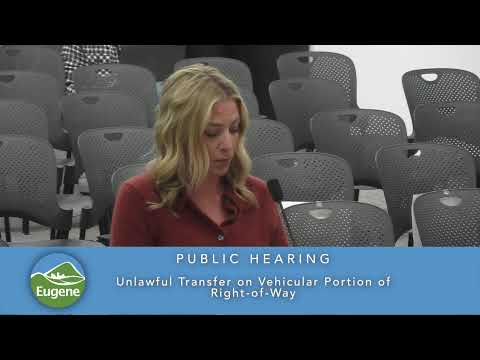
Eugene council hears extensive testimony on University of Oregon East Campus plan; record extended
Loading...
Summary
The council heard hours of pro‑ and anti‑testimony over a UO‑led package of code amendments and a rezoning covering the East Campus area. Neighbors urged remand and more study of traffic and scale; the council voted to keep the public record open through Feb. 10 to allow additional submissions.
The Eugene City Council on Jan. 20 heard lengthy public testimony over a University of Oregon request to amend the Fairmont neighborhood refinement plan, Eugene land use code, and zoning to enable expanded on‑campus housing in the East Campus area.
University representatives told council the changes are needed to align local code with the institution’s long‑range housing plan and state policy encouraging higher density near transit. "Students who live on campus have better grades, stay in school at higher rates, and graduate faster," one university representative said, and the presentation noted the university's on‑campus housing serves a racially diverse student population and is designed to be implemented on university‑owned land.
Opposition testimony came from dozens of Fairmont residents and the Fairmont Neighborhood Association (FNA). Speakers said the draft amendments are broader than characterized, would alter neighborhood designations citywide and could change the land use designation of more than 200 residential properties. "Taken together, these proposals would dismantle the refinement plan's purpose, goals, and policies," Fairmont representatives argued, and requested that council remand the application to staff and convene a mediated work group similar to prior negotiations.
Neighbors emphasized traffic and safety concerns on Agate Street and surrounding blocks during class changes and event traffic from Hayward Field and Matthew Knight Arena, saying the applicant’s transportation study does not reflect recurring short‑duration gridlocks. "Traffic analysis and mitigation should guide development, not follow it," a Fairmont resident told council.
The university and planning staff pushed back on several claims. Planning staff said they reviewed the application and concurred with the study scoping; staff also told council they will accept physical materials (including a neighborhood 3‑D model) into the record. The applicant rebuttal reiterated that refinement plans may be updated for changed circumstances and argued the proposed terminology changes are minor and maintain core policies.
Council debated two procedural motions during the hearing. Councilor Zelenka moved to allow a single neighborhood group to speak in the order they signed up rather than the randomized order; the motion failed on a council vote, recorded as two in favor and five opposed with one member absent. Later, after discussion about evidence and additional materials, council voted to extend the open record period: the first phase will end Jan. 27 at 5 p.m., the second Feb. 3 at 5 p.m., and the third and final rebuttal period Feb. 10 at 5 p.m.; that extension passed 7–2. Staff warned that a full standard 7‑7‑7 open record schedule could push formal council action dates farther into the calendar.
No final land‑use decision was made Jan. 20. The matter remains a quasi‑judicial proceeding; councilors and staff repeatedly directed speakers to focus testimony on applicable approval criteria in Eugene Code (including EC 9.8424, 9.8065, and 9.8865). Council will consider next procedural steps and any action dates after the record closes.
The hearing record will include the applicant materials, the written testimony submitted by neighborhood groups and residents, the physical model that staff agreed to accept into the record, and staff responses developed during the open record period.