Get Full Government Meeting Transcripts, Videos, & Alerts Forever!
Get email alerts on the Homelessness Services And Funding topic
No spam. Unsubscribe anytime.
Local service providers warn funding cuts will shrink shelter, rental-assistance and food programs as council weighs enforcement options
Summary
At an Astoria City Council work session, five local service providers warned of steep state and federal funding reductions — including rental-assistance cuts of 40–50% for some programs — and described limited shelter capacity and food-bank strain if SNAP benefits lapse. Providers urged the council to pursue advocacy, pop-up distribution sites and lowest-barrier shelter options.
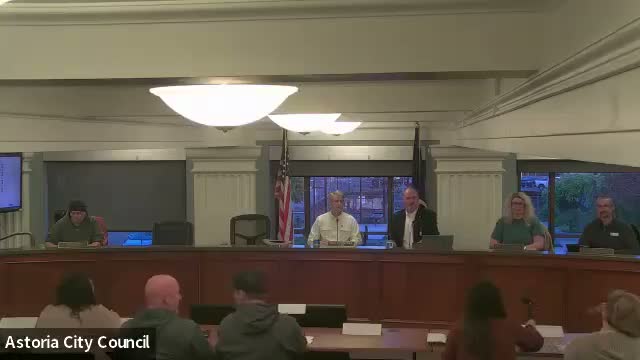
Astoria — Local nonprofit service providers told the Astoria City Council on Oct. 27 that looming state and federal funding cuts threaten shelter beds, rental-assistance programs and food distributions just as demand rises heading into winter.
“If SNAP benefits aren't funded, we're in trouble — we're gonna run out of food,” said Dustin Martin, chief operations officer of the CCA Regional Food Bank, warning that an interruption to federal nutrition benefits would sharply increase demand on local pantries.
The council convened a work session to hear five providers describe services and expected impacts. Viviana Matthews, executive director of Clatsop Community Action (CCA), said the agency delivers housing, rental and deposit assistance, energy help and a new water-assistance program for Astoria residents; Andrea Birch, CCA deputy director, said shelter funding for some programs has been cut “about 50%” and that rental-assistance enrollments have fallen “40 to 50%.” Birch said CCA sent more than 100 letters notifying families their rental assistance would end Oct. 1 and that roughly 80% of those households were re-enrolled so far.
Alan Evans, founder and president of Helping Hands Reentry Outreach Centers, described a 59‑bed Uniontown facility that recorded 14,972 overnight stays this year and said the organization faces a possible 40% cut in expected funds. “What we're gonna be facing here in the next year is gonna be dramatic,” Evans said, adding that agencies are competing for limited grant dollars and often must wait months for state reimbursements.
Providers described how capacity and the mix of shelter types affect the city’s ability to enforce camping and behavior regulations. Erin Carlson, associate director of Lifeboat Services, emphasized the need for lowest‑barrier options: “They're not necessarily ready for high barrier shelter. They might be ready for a low barrier shelter.” Lifeboat’s executive director said the organization currently turns people away nightly and estimated Lifeboat could house about 22 more people if an occupancy increase previously approved for a commercial space were restored.
Councilors repeatedly asked whether people experiencing homelessness are local or “outsiders.” Multiple providers said most clients have local ties. “The vast majority of people coming to our shelter are locals,” said a Lifeboat representative. Susan Prettyman Hartle, deputy director of The Harbor (the county’s domestic‑violence services provider), said about 35% of the Harbor’s clients were unsheltered last year and that the agency relies on roughly 60% federal funding.
Councilors pressed providers on what the city can do immediately. Suggestions from providers included: using city property as distribution points for food and supplies; facilitating pop‑up awareness events so residents understand available services; advocating to state and federal elected officials for more timely and adequate funding; and working with the county on sanctioned low‑barrier camps or city‑owned sites that agencies could operate.
Mayor Fitzpatrick and Councilor Davis asked staff to gather written budgets and follow up with the city manager so the council can consider targeted next steps. The meeting closed with council members thanking the providers; Councilor Lum, who stated this was his final meeting, offered brief farewell remarks.
The council did not adopt any ordinance or take a formal vote at the session. Providers were asked to follow up with written budget details to the city manager so council members can review specific shortfalls and consider assistance options.