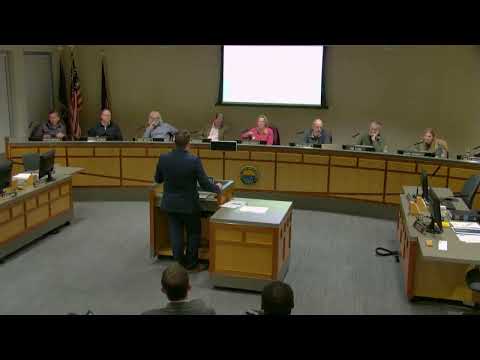
Planning commission approves hospital parking-ramp expansion with conditions after resident objections
Loading...
Summary
The East Grand Rapids Planning Commission approved a site plan to expand the hospital’s north parking ramp on Wealthy Street, attaching conditions including post-construction traffic and lighting reviews, continued off‑site lease maintenance and measures to manage parking. Neighbors urged bigger mitigations, citing safety and data concerns.
The East Grand Rapids Planning Commission voted to approve a site plan for an expansion of the hospital’s north parking ramp on Wealthy Street after public presentations from city staff, traffic consultants and Corewell Health and an hour of resident testimony. The commission attached conditions including maintenance of off-site parking leases, a deed‑style agreement limiting future height-variance requests at the ramp site, and post‑construction traffic and lighting verification.
City deputy manager Doug Lefebvre framed the review around the planning standards in section 5.87, telling commissioners the proposal must be judged on those criteria and noting staff identified several conditions they recommend for approval. "We want to have those conditions there too in addition to noting some of the other conditions that were based off of staff review," Lefebvre said during his presentation.
Corewell Health’s director of planning and construction, Rodney Vanderzand, said the design team revised materials after commissioner and neighborhood input and emphasized the project’s goal is to meet existing demand on campus rather than to increase trips. "Our intent is not for every space to be filled," Vanderzand said, adding the work is meant to reduce off‑campus parking and circling that can create congestion.
Traffic consultants who reviewed the proposal said the expansion is not expected to materially change traffic operations across the study intersections once timing changes the city has implemented are included. "With the implemented timings, all movements, all approaches, and all intersections were at a level of service A‑D or better," said Kyle Reitzma, senior traffic engineer with Fishback. Progressive Companies’ traffic engineer Joe Everly said simulated worst‑case southbound queues on Plymouth increase from about 340 feet to about 370 feet with the expansion — roughly one car length on average — and remain short of the first private driveway at about 450 feet.
Neighbors and nearby residents urged the commission to reject or further condition the project. Jodi Ostrowski of Plymouth Road said local streets already show speeding, trash and near misses, and questioned whether the study’s two days of December counts reflected typical traffic patterns. "How is adding an additional 206 spaces with one entry and one exit entirely on Plymouth Road not going to cause more problems?" she asked. David Brown of Plymouth suggested alternatives — better transit through the campus, rideshare and digital parking guidance to reduce circling for drivers.
In response to resident concerns, staff and the applicant agreed to several conditions to increase accountability and mitigation: maintain the off‑site Aquinas lease parking until the city is satisfied it is no longer needed; stain and finish visible bare concrete to match campus materials; require post‑construction verification of traffic performance six months after occupancy with a commitment to remedy operations that fall below LOS D; complete a post‑construction lighting verification and mitigate glare or spillage as needed; provide micro‑mobility (secure bike and e‑bike) storage to staff satisfaction; and implement parking‑management best practices, including consideration of digital guidance counters.
Commissioners discussed whether the ramp addition meets the R‑1 zoning standard for stories and height; one commissioner said they struggled with whether the added open level counts as an additional story. After debate, a motion to approve the site plan with the enumerated conditions passed. The commission chair announced the motion carried with one dissenting vote.
Corewell representatives said construction is expected to last roughly seven months, with five concrete pours and limited closures. Applicant and city staff also said construction workers will be required to park on campus or be shuttled in to prioritize patient and visitor parking and that staff will post a single point of contact for residents during construction.
The commission’s approval is conditional and requires the applicant to implement the listed mitigation measures and to provide the post‑occupancy studies; the planning department will monitor and report back on the conditions.