Get Full Government Meeting Transcripts, Videos, & Alerts Forever!
Get email alerts on the Community Engagement topic
No spam. Unsubscribe anytime.
County launches community survey to guide $1M-per-district 'Community Impact Fund' allocations
Summary
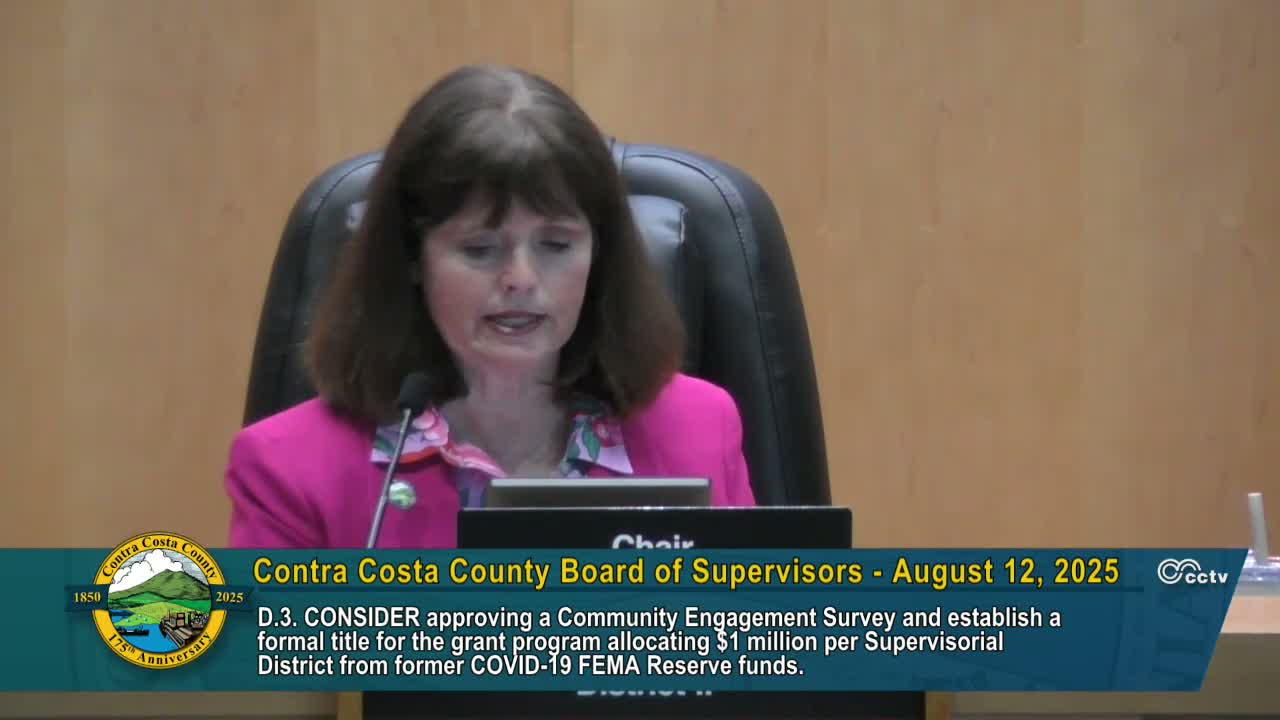
Contra Costa County staff proposed a countywide community engagement survey to inform distribution of $1,000,000 per supervisorial district from former FEMA/ARPA reserve funds. The board selected the program title "Contra Costa Community Impact Fund" and asked staff to finalize survey language and include food insecurity and senior services.
Contra Costa County presented a countywide community survey and options for allocating $1,000,000 per supervisorial district on Aug. 12, 2025.
Staff recommended a 10'question sentiment survey plus six demographic questions (ZIP code and supervisorial district required). The county plans to host town halls, provide translations and distribute a QR code; the survey will be anonymous and stored on county servers (Microsoft Forms) to avoid collecting personally identifiable information.
Board discussion: Supervisors debated three approaches: a single countywide survey, a hybrid (common questions plus district'specific add'ons) or separate district surveys. Several supervisors favored a hybrid approach to preserve countywide comparability while allowing each district to add localized questions. Community speakers urged inclusion of food insecurity, senior services, childcare and job training as explicit categories and requested that survey results be disaggregated by ZIP code, race/ethnicity and income.
Outcome and next steps: The board settled on the program title "Contra Costa Community Impact Fund" and directed staff to refine the survey (add food insecurity and seniors categories, ensure translations) and to share district'level results so supervisors can use them to inform allocations at the Oct. 21 board meeting. Supervisors may choose local application processes (some prefer hybrid application + direct allocations).