Lifetime Citizen Portal Access — AI Briefings, Alerts & Unlimited Follows
DPH updates commissioners on CalAIM rollout, revenue gains and federal funding risks
Loading...
Summary
Department of Public Health officials updated the commission on CalAIM implementation, reporting $17 million in CalAIM-related revenue to date for DPH and expanded Enhanced Care Management (34,000 encounters), while warning that federal waiver renewals and proposed federal rules could jeopardize some programs and hundreds of millions in funding.
San Francisco ——
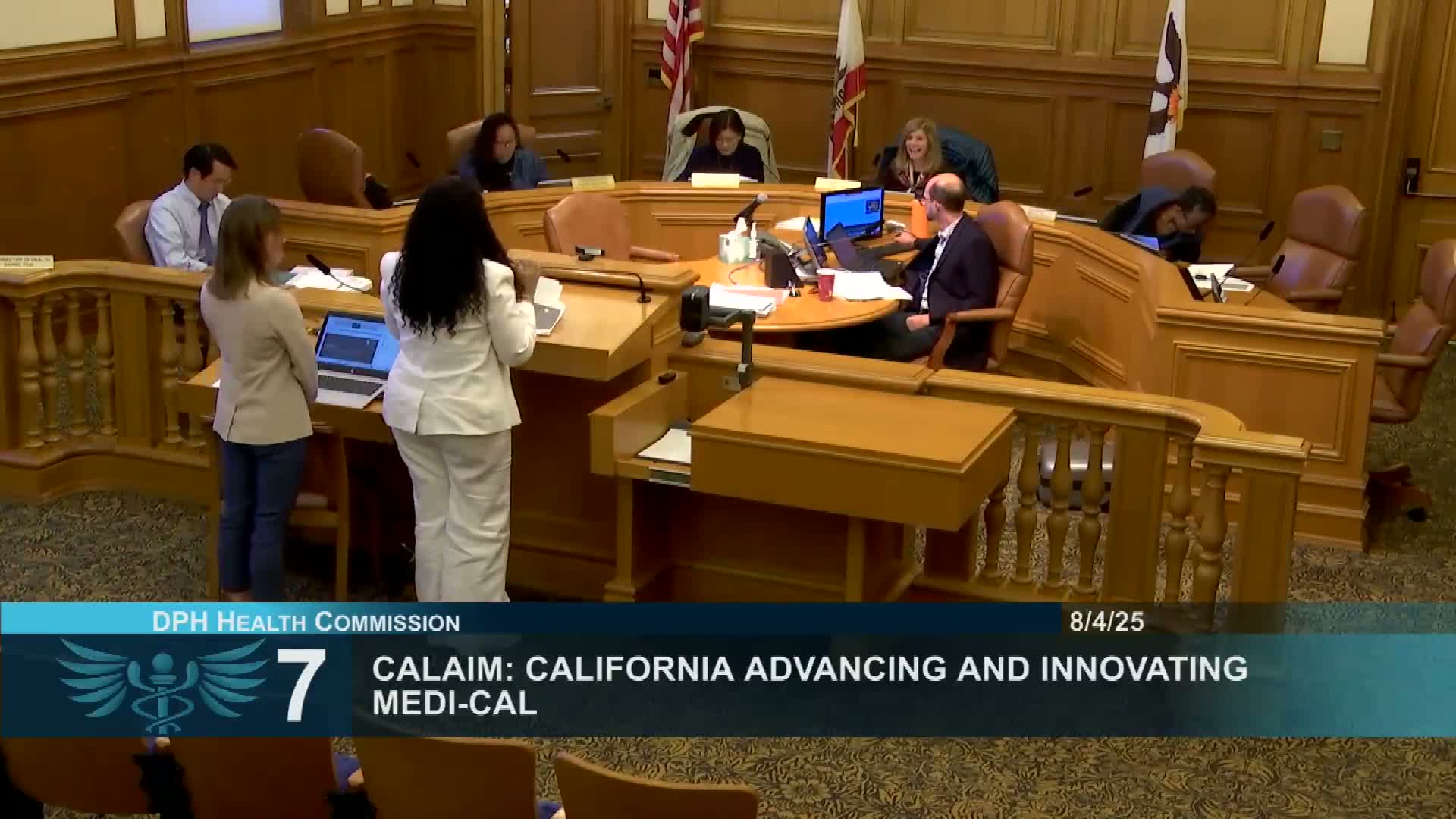
Department of Public Health leaders told the Health Commission on July 29 that CalAIM (California Advancing and Innovating Medi-Cal) has expanded the city's care-management capacity but faces financial and regulatory uncertainty. Dr. LaDonna Norman, Director of Intensive Services and Access for the adult and older-adult system of care, said CalAIM began in 2022 and is intended to "make services more equitable, mitigate barriers and access to care, address our marginalized and stigmatized populations, and implement a whole-person centered approach."
Norman said DPH's Enhanced Care Management (ECM) teams have provided about "34,000 ECM encounters" since CalAIM launched, and described community supports that have reached 12,000 clients. A second presenter noted that, from launch to present, DPH community supports and ECM have generated roughly $17 million in revenue, with other CalAIM-related one-time awards to the city totaling about $74 million.
The presenters outlined priority populations for CalAIM: people experiencing homelessness, those with severe mental illness, people with substance-use disorders, foster youth and people transitioning from incarceration. Norman highlighted a justice-involved reentry workflow that links pre-release referrals to post-release appointments and warm professional handoffs so clients do not lose care when released.
Commissioners questioned how CalAIM revenue compares with the previous Whole Person Care reimbursement model and how small community-based organizations (CBOs) can manage the administrative demands of billing and documentation. The presenters acknowledged operational hurdles: "the requirements, the administrative requirements for documentation, invoicing, revenue cycle management, reporting, they're quite difficult," one presenter said, noting that some CBOs may need hub arrangements or technical assistance to bill Medi-Cal effectively.
Director Tsai framed CalAIM progress amid a broader budget warning. Tsai said the department has secured a formally passed budget and is pursuing more than half a billion dollars in additional health-plan reimbursements to preserve services. But he cautioned that proposed federal changes, including work requirements and more frequent eligibility checks, "will lead to millions of people across the country losing their health care coverage," and that the city faces potential losses "in the hundreds of millions of dollars." He said DPH and HSA are analyzing the federal bill's likely local impacts and planning mitigation strategies.
Presenters also described operations improvements: increased ECM links to palliative care and behavioral health, expansion of community supports into transitional rent planning for 2026, and investments in closed-loop referral software integrated with Epic to track whether referred clients actually receive services. One presenter said expanding revenue-cycle management capacity and launching a Medi-Cal billing playbook are priorities to help CBOs participate.
The commission requested follow-up data and timelines. Commissioners said the potential scale of federal funding cuts makes CalAIM implementation's sustainability a central question for forthcoming meetings.
The commission did not take a formal vote on CalAIM during the presentation; presenters offered to return with additional data.