Pacifica council launches shoreline adaptation planning process, allocates $150,000 and forms ad hoc committee
Loading...
Summary
Staff outlined next steps to implement the certified Local Coastal Land Use Plan, including development of a Shoreline Adaptation Program and a Coastal Access and Resilience Program; council approved an ad hoc subcommittee to provide guiding parameters for a consultant RFP and staff said $150,000 is budgeted to begin planning and engagement.
City staff presented a study session on implementing Pacifica's certified Local Coastal Land Use Plan (LCLUP) and the city's obligations under state sea‑level‑rise planning guidance (SB 272). Community Development Director Samantha Updegrave and planning staff described two core programmatic efforts: the Shoreline Adaptation Program (SAP), a technical and planning process that establishes baseline conditions, milestones and funding pathways, and the Coastal Access and Resilience Program (CARP), a citywide menu of mitigation and access projects that must be updated periodically.
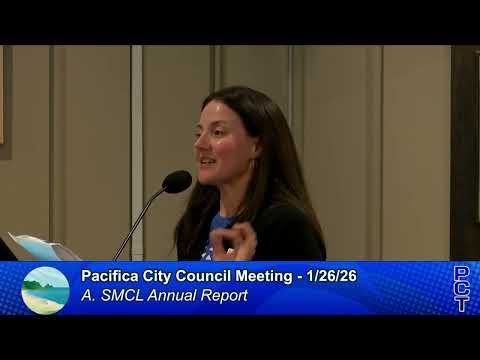
Associate Planner Caitlin Snodgrass and Civic Spark fellow Samuel Cusad described the LCLUP's Special Shoreline Resiliency Areas (SSRAs), noting those provisions may only be "sunrised" (made effective) after SAP and CARP milestones are achieved, and that SSRAs are limited by scope, duration and applicability. Staff said the city currently has $150,000 in the budget to initiate shoreline adaptation planning and community engagement and plans to issue an RFP for a consultant or consultant team with both coastal technical expertise and community‑engagement experience.
Public commenters urged robust, transparent outreach, recommended nature‑based alternatives where feasible, and asked for clear information on costs, lifespans, impacts and potential relocation of infrastructure (sewage pump stations, etc.). Residents repeatedly said prior engagement felt predetermined and asked that listening sessions be conducted in neighborhoods and by methods that reach people who do not attend council chambers.
Council members discussed starting with a long‑term vision, using listening sessions and community‑driven approaches to rebuild trust, and ensuring the RFP emphasized both technical coastal expertise and creative engagement methods. Several council members noted the need to be grant‑ready to secure larger state funds once a consultant is onboarded.
To advance the next phase, Council Member Beier moved — and Vice Mayor Wright seconded — to create an ad hoc subcommittee consisting of Councilmembers Beckmeier and Mayor Bowles with the direction to provide input ensuring alignment with council priorities on community engagement guiding parameters to be included in the RFP, beginning with the first task of establishing guiding parameters. The motion passed unanimously.
Staff said the ad hoc will work with staff to return to council with RFP language and recommended outreach approaches; the $150,000 allocation will be used to initiate the consultant process while staff pursues state grant funding for subsequent phases.