Get AI Briefings, Transcripts & Alerts on Local & National Government Meetings — Forever.
SolarSPELL health library brings offline medical content to low‑connectivity settings, presenters say
Summary
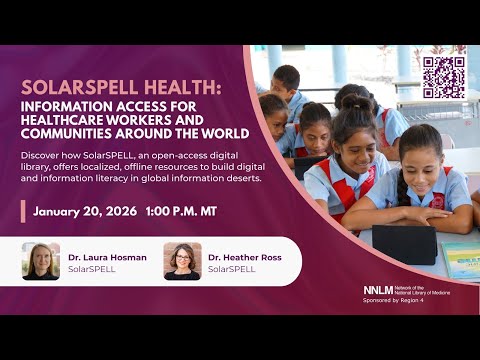
At an NNLM Region 4 webinar, SolarSPELL cofounders described their solar‑powered offline libraries and localized health collections used in places from South Sudan to Arizona, highlighting partnerships with nursing programs, Phoenix crisis responders and tribal health programs.
Dr. Laura Hosman, cofounder and co‑director of SolarSPELL at Arizona State University, and Dr. Heather M. Ross, director of the SolarSPELL Health Global Library Initiative and assistant professor at ASU's Edson College of Nursing and Health Innovation, told an NNLM Region 4 webinar that SolarSPELL combines offline, solar‑powered hardware with curated, locally relevant digital content and train‑the‑trainer programs to support learners where Internet access is limited.
The presenters said the libraries operate on a small microcomputer (a Raspberry Pi) that creates an offline Wi‑Fi hotspot; users connect with a smartphone or laptop and access downloadable PDFs, videos and audio without an Internet connection. "We believe access to information is a human right," Hosman said, adding the design is rugged and portable and can support roughly two dozen simultaneous users.
The nut of SolarSPELL’s approach, presenters said, is local curation and skills training. Ross described how a 2017 Peace Corps request led SolarSPELL to develop a health collection for volunteers in Vanuatu, and how subsequent field work in places such as South Sudan and Malawi shaped the health library's content and deployment model. Ross said nursing students and instructors in Malawi used the libraries on clinical detachments, downloaded instructional videos and textbooks, and reported improved confidence and practice; she described one training follow‑up that found a 9‑point systolic drop in an example where learners used behavioral‑change materials, a reduction Ross said translates to an estimated lower stroke risk.
Presenters summarized impact and scale as reported by SolarSPELL: they said the project has reached hundreds of thousands of learners (presenters cited "more than 496,000"), reported high self‑reported learning gains among users (presenters quoted 92% and 88% figures for preparedness and digital literacy improvements), and estimated roughly 700 libraries across about 15 countries. Hosman and Ross described awards and recognition SolarSPELL has received and said the initiative maintains an ongoing schedule of review and updates for library content to keep materials evidence‑based and locally relevant.
The webinar covered several use cases beyond classroom learning. Ross described a partnership with the Phoenix Fire Department Community Assistance Program to put SolarSPELL libraries on response rigs: presenters said responders previously handed paper pamphlets to people in crisis but worried materials would be lost or unusable; the offline libraries allow responders to provide low‑literacy, image‑based materials and curated child‑appropriate videos safely without Internet exposure. Hosman and Ross also described a Hopi tribal partnership that restricts Hopi‑specific content to the Hopi library and discussed early outreach to the Indian Health Service.
Audience questions addressed potential FEMA collaboration (presenters welcomed such conversations but had no active FEMA partnership), device durability and repair (hosts said devices are triple‑tested, have no moving parts, and that partners typically keep spare units and handle updates over the offline network), and copyright (SolarSPELL uses open‑access materials or items with explicit permission).
The presenters emphasized cultural vetting: content on topics such as gender equity or LGBTQIA+ issues may be excluded or localized depending on local acceptability and risk, and SolarSPELL interns receive cultural‑awareness training while partners review content before deployment. The pair said SolarSPELL relies heavily on partnerships and local hosts for updating libraries and organizing train‑the‑trainer sessions.
The webinar concluded with contact information for NNLM Region 4 and an invitation to collaborate. The presenters invited recommendations for funding or implementation partners and said they expect additional deployments soon, including expansion into another country in West Africa.
The claims and statistics above reflect statements made by the presenters during the webinar; newsroom follow‑up would be needed to independently verify counts, impact metrics and award dates.