Get Full Government Meeting Transcripts, Videos, & Alerts Forever!
Get email alerts on the Portal Project topic
No spam. Unsubscribe anytime.
TJPA adopts master schedule and interagency MOU, advances Portal toward FFGA readiness
Summary
The Transbay Joint Powers Authority board received a detailed three‑year master schedule and funding plan for the Downtown Rail Extension (Portal/DTX), approved an interagency implementation memorandum of understanding to coordinate delivery, and directed staff to continue advocacy for state and regional funding to close a remaining local match gap.
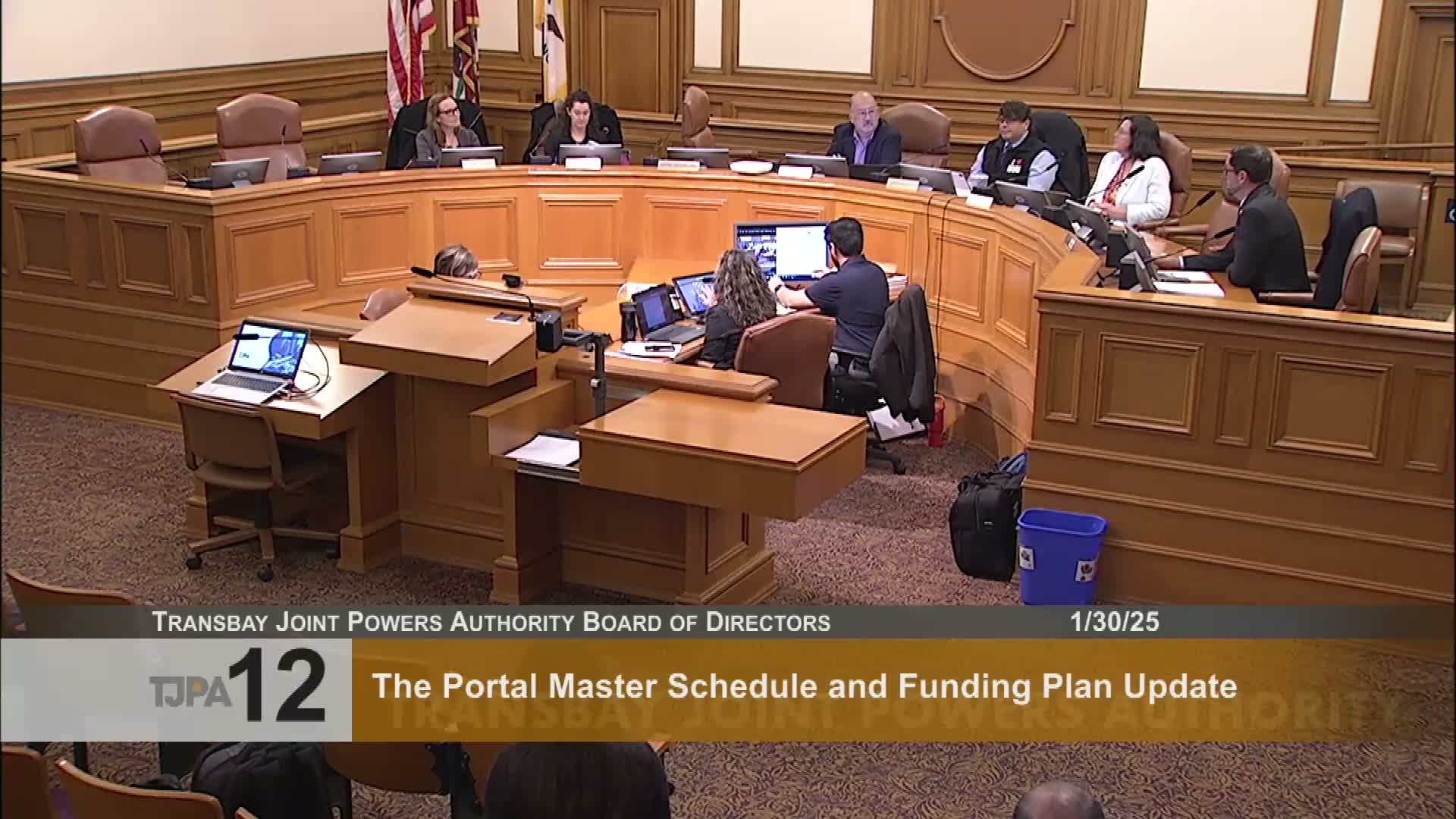
The Transbay Joint Powers Authority on Jan. 30 approved a six‑agency implementation memorandum of understanding and reviewed a master schedule and funding plan designed to position the Downtown Rail Extension (the Portal or DTX) for a Full Funding Grant Agreement (FFGA) target date of July 2027.
The board’s action authorizes Chair Jeff Gee to execute the interagency MOU, which staff and partner agencies say formalizes governance, defines an annual multiagency work program and calls for a standing Portal committee to be established before award of any construction contract. Jesse Koehler of the San Francisco County Transportation Authority told the board the agreement implements a governance blueprint developed over multiple years and will help coordinate the five partner agencies as the project seeks additional funds.
Project Director Alfonso Rodriguez summarized the technical and funding milestones staff expect over the next three years: advance the largest civil and tunnel procurement, complete design and engineering work to reduce contingency, perform targeted enabling works and secure the additional local and state match needed to pair with $3.38 billion in Federal Transit Administration Capital Investment Grant (CIG) commitment identified in the project’s capital plan. Rodriguez noted the civil and tunnel contract will be delivered as a progressive design‑build, with an initial pre‑construction authorization (NTP1) to advance design to roughly 60% before negotiating a guaranteed maximum price.
CFO Shima Mirzai presented the funding profile underpinning the schedule. The board was shown a multi‑year cash‑flow that anticipates near‑term expenditures for design, property and preconstruction activities and a larger funding need beginning in fiscal year 2026 and escalating into 2028 if additional matching funds are not secured. Staff told the board the plan assumes use of a mix of sources — federal competitive grants, reauthorization of California cap‑and‑trade funds, components of a regional transportation measure (RM2/RM3), land‑secured financing and other discretionary grants — and that the agency must secure roughly $2.5 billion by mid‑fiscal 2027 to remain on the FFGA timeline.
Directors pressed staff on risk and contingency. Several board members urged extra work to advance the design from 30% to 60% to reduce unallocated contingency and lower the match requirement for the FFGA. Vice Chair Mandelmann, noting the political uncertainty at federal and state levels, framed the plan as ‘‘aggressive but potentially achievable’’ and asked staff to marry the schedule of deliverables to a parallel schedule identifying when specific funding commitments must be made to satisfy FTA requirements.
Rodriguez and Vandewater said the project will keep a risk register and maintain several ‘‘off‑ramps’’ so work produces durable outputs even if some funding paths are delayed; examples included taking design to higher completion or deferring some station fit‑out work until a later phase. Rodriguez emphasized the need to hire the progressive design‑build contractor to refine scopes, sequences and cost estimates and said that until a contractor is on board, the program will carry a higher contingency because underground utilities and unknown subsurface conditions remain partially unresolved.
After discussion, the board voted to approve the implementation MOU. Director roll call recorded unanimous approval by the members present.
The MOU and the funding plan do not themselves obligate funds beyond the amounts already appropriated; they set governance and program priorities. Staff said next steps include releasing the RFP for the civil and tunnel package, continuing state and regional advocacy for cap‑and‑trade and regional measure dollars, and briefing partners and the Bay Area congressional delegation on the short‑term funding needs needed to keep the project on the FFGA path.