Get Full Government Meeting Transcripts, Videos, & Alerts Forever!
Get email alerts on the Healthy Universal School Meals topic
No spam. Unsubscribe anytime.
LESC: Universal school meals raised participation, but oversight and infrastructure lag
Summary
A Legislative Finance Committee evaluation presented to the Legislative Education Study Commission found New Mexico’s Healthy Universal School Meals law increased participation but left gaps in meal-quality monitoring, kitchen infrastructure and staffing; the Public Education Department accepted most recommendations and committed to new monitoring and training.
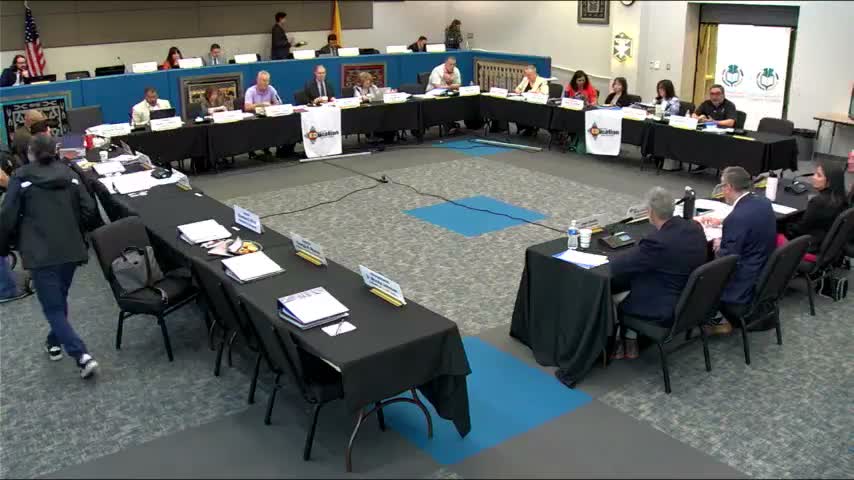
The Legislative Education Study Commission heard an LFC evaluation in Gallup showing New Mexico’s Healthy Universal School Meals law has increased participation but that improvements in meal quality remain unclear because the Public Education Department has not yet tracked compliance statewide.
"The law now mandates free, high quality meals for all public school students, regardless of income," LFC evaluator Dr. Ryan Tolman told commissioners as he outlined the report’s scope and findings. The LFC found lunch participation rose by about 8.5 percentage points and breakfast by 8.3 points after the law’s 2023 implementation.
The report said state investment in universal meals rose about 20%—from $206 million in school year 2023 to $247 million in 2024—and total food-service spending increased from $165 million in 2018 to $248 million in 2024. LFC analysts flagged that per-student food spending rose from $1.03 to $1.71 per day over that period and estimated average program cost at roughly $4.61 per student per day in 2024.
LFC program evaluator Josh Chaffin said the law’s quality requirements (including a rule that at least 50% of weekly meal components be prepared from scratch) are ambitious and that smaller districts and many charter schools face barriers. "Most school food authorities aren't yet meeting that threshold today," Chaffin said, citing outdated kitchen infrastructure, staffing shortages and limited vendor access as primary obstacles.
The LFC recommended that PED provide clearer guidance and monitoring, standardize a student satisfaction survey, increase technical assistance and training for kitchen staff, and require Food Service Management Company contracts to include the new quality expectations. "First is for PED to provide schools with guidance and monitor the use of SEG funds with special attention to smaller districts and charter schools," the report says.
Public Education Department officials said they accept most recommendations and outlined near-term actions. Greg Frostad, assistant secretary at PED, called the law “one of the most significant accomplishments” and said the agency is seeking to maximize federal funding while requesting flat recurring state funding for fiscal 2027 plus $5 million nonrecurring for potential cost overruns.
Laura Henry Hand, Student Success and Wellness Bureau chief at PED, described steps already underway: targeted culinary and scratch-cooking training, a chef symposium, updated FSMC (food service management company) forms, and a student- and family-facing survey distributed via QR codes. She also said PED carved $2,000,000 from the Healthy Universal School Meals appropriation this year to continue support for the New Mexico Grown program.
Commission members pressed PED and LFC on the pace of capital spending for kitchen upgrades—LFC estimated about $31 million was needed when the bill was written; about $24 million in state and federal funds have been allocated since FY23, with roughly 29% spent as of April—and on how schools will meet scratch-cooking requirements given staffing and space constraints. PED acknowledged that retrofits and procurement take time and noted targeted grants and training to address bottlenecks.
The LFC also cautioned that changes in federal eligibility rules could affect reimbursements: LFC staff estimated roughly 3% of the student population and about 20 schools could be affected by recent federal budget-reconciliation proposals, with broader effects not expected until around 2030 as PED works through direct-certification changes.
The commission requested follow-up reporting and more complete outcome tracking. LFC staff recommended that PED and districts develop systems to tie meal participation to student outcomes—attendance, grades and health measures—once certification and monitoring are in place. The PED said certification and the first full year of monitoring should provide clearer measures of compliance and quality.
Next steps: PED indicated it will begin the monitoring and training activities laid out in the presentation and return with updated certification results and survey findings in the coming year.