Lifetime Citizen Portal Access — AI Briefings, Alerts & Unlimited Follows
State agencies outline $20M program to tackle neglected contaminated sites and uranium mines
Loading...
Summary
NMED and the State Land Office briefed the committee on a $20 million special appropriation for remediation: $6M targeted at two contaminated soil sites (Tucumcari truck terminal and AREX refinery) and $12M to begin cleanup of abandoned uranium mines; officials said 348 orphan sites were identified and that further sustainable funding will be needed.
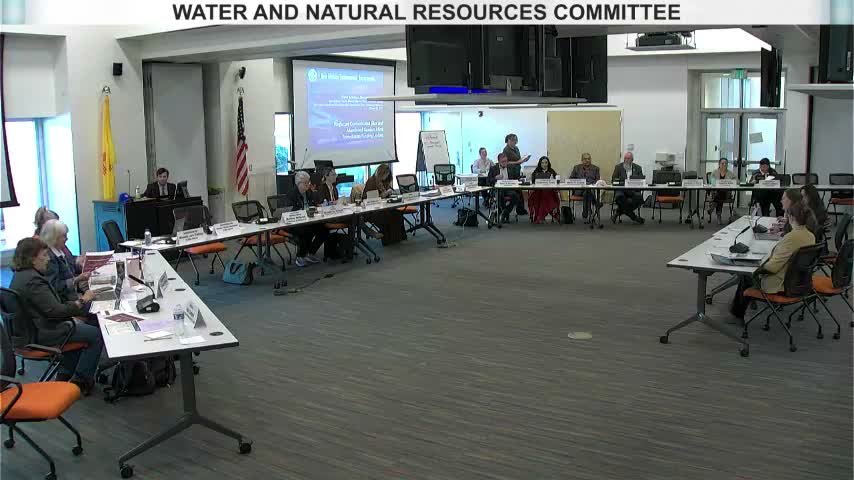
At an Artesia interim session of the Water & Natural Resources committee, New Mexico Environment Department (NMED) officials described how a $20,000,000 special appropriation is being applied to remediate neglected contaminated sites and abandoned uranium mines that lack responsible parties.
Kelsey Raider, deputy director of NMED’s Water Protection Division, said the appropriation focuses on soil and groundwater resources and is intended to return properties to productive use. Raider described two priority projects that together are allocated $6,000,000: the Tucumcari Truck Terminal, where a vandalized oil tank in 2024 led to petroleum contamination of soil and groundwater (phase‑1 and phase‑2 assessments are complete or nearly complete), and the AREX refinery in San Juan County, which NMED plans to remediate and convert into a public park with about $1.3 million of the remediation set aside for construction work.
Myori Harms, the uranium mine reclamation coordinator, explained the $12,000,000 strand of the appropriation for abandoned uranium mines. Harms said NMED contracted six qualified cleanup partners (named in committee handouts) to address several state‑trust‑land mines, including the Schmidt Decline, Mo Number 4 and Red Bluff Number 1. The contracts were competitively procured for up to four years; contractors were required to demonstrate capabilities such as a certified health physicist, professional engineer and professional geologist. Harms emphasized the program’s partnership with the State Land Office, EPA and federal programs and noted the uranium cleanup act (2022) provides statutory authority for this work.
Officials told the committee they have identified roughly 348 sites statewide lacking responsible parties; 46 of those are neglected uranium mines. The panel described the work as a mix of assessments, cultural and biological resource surveys, radiological scans, surface reclamation and, where appropriate, options for on‑site repositories or transport to permitted disposal facilities. NMED staff said they will choose approaches case‑by‑case depending on radioactivity, geology and funding. The department acknowledged that groundwater remediation (especially radiologically contaminated groundwater) is technically complex and was not included in the current fiscal‑year surface remediation work because of time and cost constraints.
Legislators pressed on long‑term costs, disposal capacity and workforce development. Senator Scott and others characterized the current appropriation as modest relative to potentially large remediation needs; NMED officials said a $100,000,000 ask would be an appropriate start to scale the program, while cautioning that total costs could range into the hundreds of millions or more depending on groundwater involvement and site complexity. George Schumann, remediation oversight section manager, noted several commercial facilities in New Mexico and the region that can accept petroleum‑contaminated soils (Rhino Environmental, EnviroTech, Camden Marley), but said disposal location materially affects project cost.
On community and cultural issues, Harms said cultural resource surveys and archaeology are integrated into site assessment to avoid disturbing tribal or culturally significant areas near Mount Taylor and other locations. NMED and the state land office described a process of public notice and coordination with the State Land Office for projects on trust land.
No final policy vote was taken at the Artesia meeting; presenters requested sustainable, recurring funding and signaled plans to continue shovel‑ready projects in the upcoming construction season.