Get Full Government Meeting Transcripts, Videos, & Alerts Forever!
Get email alerts on the Holocaust Remembrance topic
No spam. Unsubscribe anytime.
At UN Holocaust Remembrance, leaders and survivors call for action against rising antisemitism
Summary
At a Jan. 27 UN observance marking the International Day of Commemoration for the Victims of the Holocaust, Secretary‑General Antonio Guterres, General Assembly President Annalena Baerbock, Israel’s ambassador Danny Danon and others urged education, accountability and immediate action to counter growing antisemitism while survivors gave testimony.
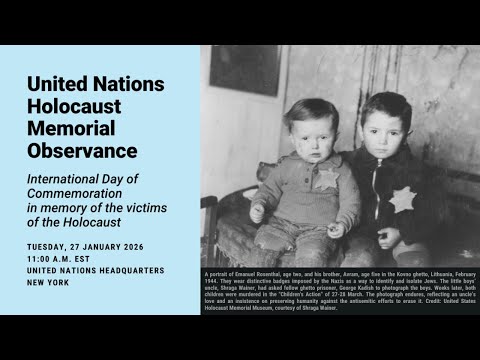
UNITED NATIONS — World leaders and Holocaust survivors urged immediate action to confront rising antisemitism at the United Nations’ International Day of Commemoration for the Victims of the Holocaust on Jan. 27.
United Nations Secretary‑General Antonio Guterres said remembrance must be active, not passive. "Remembrance is more than honoring the past. It is a duty and a promise to defend dignity," Guterres said, warning that "hatred, once unleashed, can consume everything" and linking the Holocaust’s origins to the erosion of democratic institutions and the manipulation of information.
President of the General Assembly Annalena Baerbock echoed that warning, saying "Never again is not a slogan. It's a duty," and urging stronger Holocaust education and efforts to counter denial and distortion. Baerbock announced a live guided virtual tour of Auschwitz‑Birkenau to be held at the UN as part of those educational efforts.
Israel’s permanent representative, Danny Danon, told ambassadors that "the time for talk is over. The time for action is now," and urged them to gather domestic data on antisemitic incidents, threats, arrests and prosecutions. Danon also criticized what he described as failures within the UN to counter false narratives, citing an asserted claim by a senior UN official that "14,000 babies would die within 48 hours" and calling that particular claim "made without evidence." The assertion was presented by Danon as an example of statements he said the institution had failed to correct; the claim in his speech was attributed to a senior UN official and was not substantiated with evidence in the observance record.
U.S. Permanent Representative Michael Waltz recalled Allied liberators and urged international cooperation on education and restitution. Waltz cited recent civil‑society and research figures during his remarks, referencing data reported by organizations including the Anti‑Defamation League on rising antisemitic incidents and saying the surge showed a need for stronger prevention and protection measures.
Survivors’ testimonies formed the heart of the observance. Evelyn Conrad and other survivors recounted childhood memories of displacement, deportation and loss; 91‑year‑old Sarah Weinstein described hiding with a Ukrainian family, the murder of her parents and the long aftermath. Weinstein told the assembly: "Don't forget ... the Holocaust did not begin with gas chambers. It began with words, incitement, propaganda, jokes, accusations and indifference," and urged every listener to speak up when they witness hate.
Organizers repeatedly framed remembrance as a spur to concrete steps: improved education, open archives, full restitution where relevant, and prosecutions where laws are broken. The program also included musical performances and prayers; Cantor Rafael Frieder recited memorial prayers near the close of the observance.
Context and next steps: speakers invoked General Assembly Resolution 60/7, the UN’s formal Holocaust remembrance mandate, and called on member states and missions to translate the day’s rhetoric into domestic action, including education initiatives and gathering incident and prosecution data. The observance concluded without formal votes or institutional decisions at the assembly; participants left with calls for renewed national and multilateral commitments to counter antisemitism and to preserve survivor testimony.