
Colorado and Texas legal-aid teams pilot automated texting and case‑management surveys to capture client feedback
Get AI-powered insights, summaries, and transcripts
Subscribe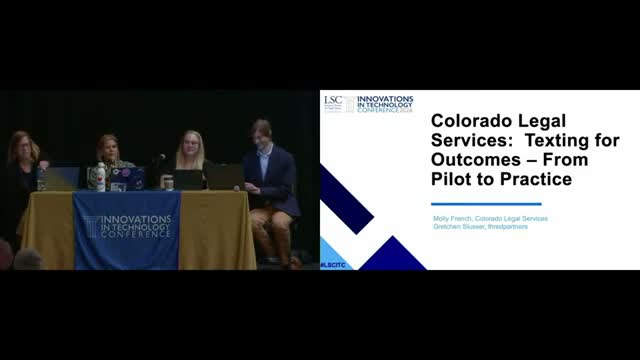
Summary
Presenters from Colorado Legal Services and Lone Star Legal Aid described pilots that use LegalServer and Twilio to send brief SMS prompts and longer surveys, reporting higher SMS response rates, specific workflow lessons, and operational guardrails such as consent and timing.
Gretchen Slesser, a consultant with Fred Partners, and technology and data staff from Colorado Legal Services and Lone Star Legal Aid described pilot projects that use automated workflows to collect client satisfaction and outcome data.
"Texting is king," Slesser said, summarizing one striking finding from the Colorado pilot: SMS prompts produced higher return rates than traditional email or paper surveys. Molly French, director of technology at Colorado Legal Services, described the technical setup: "We used LegalServer's SMS module... then we tied it into Twilio," and worked with partner offices to adapt lessons from a similar project at Legal Services Cleveland.
Colorado's approach began with a single SMS question; respondents who indicated a positive outcome were routed to a longer SurveyMonkey or LegalServer survey with branching logic and plain-language items. The teams emphasized designing questions for short mobile responses and reducing the number of steps when possible. "If there's any way we can take it down to 2 [questions], we probably get a better response," French said.
Timing and trigger logic proved critical. The presenters tested sending prompts at different points — initially after cases were closed, then experimenting with a 10‑day post‑open trigger for some case types — and ultimately reverted to case‑closure triggers after some clients reported they had not yet received services when surveyed too early. The Colorado team applied exclusion rules (for example, cases involving domestic violence) and required that clients opt in to receive texts in intake.
Lone Star Legal Aid's Nick Whitaker described a more email‑centric rollout driven by organizational readiness: "We set a trigger — a case closure — and we send surveys via email. We sent out 15,000 satisfaction surveys for A's and B's, about 1,500 for extended service," he said. Whitaker added that response rates from email surveys varied regionally and averaged roughly 5–20 percent, lower than SMS results but still useful for trend analysis.
Presenters stressed practical safeguards: build surveys inside the case‑management system when possible to trace answers back to case records; add case notes when surveys are sent; and have managers receive regular reports. They offered materials and template workflows to attendees and encouraged offices to pilot small changes (timing, question count, language access) before scaling.
The session closed with offers to share grant documents and project handouts and invitations to contact the teams for technical assistance. Presenters said the next steps are focused on expanding multilingual outreach and continuing to refine trigger logic and reporting pipelines.