Get Full Government Meeting Transcripts, Videos, & Alerts Forever!
Get email alerts on the Proffers topic
No spam. Unsubscribe anytime.
City staff outlines proffers and possible school-proffer formula; cautions on limited eligible uses
Summary
Staff summarized changes to Virginia proffer law and explained how a per-student proffer formula (using the FCPS benchmark of $14,956 per expected student) could be applied; council asked about timing, 12-year limits and what happens to unused funds (they are returned to the state).
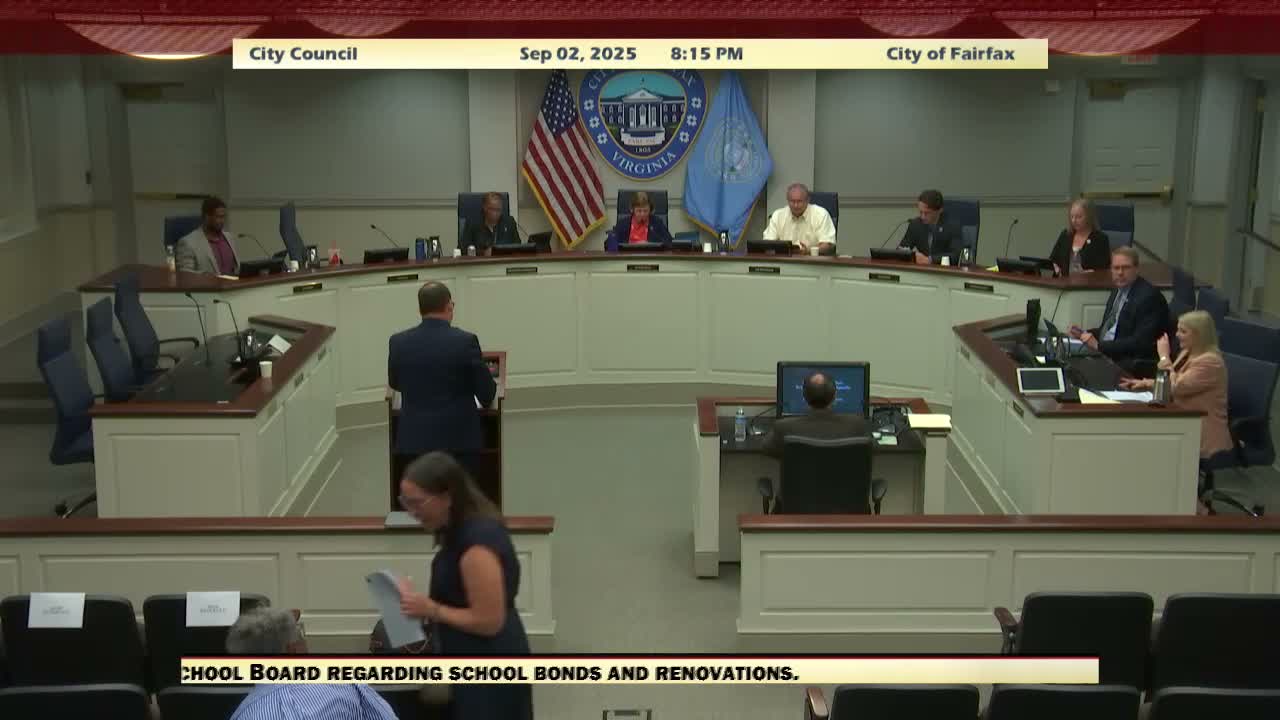
City planning staff and consultants briefed the City Council and School Board Sept. 2 on development proffers and how state law and local policy shape what proffered funds may be used for.
Presenters reviewed the 2016 changes to Virginia law that tightened judicial review standards and limited allowable proffers to contributions that are directly attributable to and materially benefit new residential development. Staff emphasized that cash contributions must be used for capital projects that expand capacity and must begin within 12 years of acceptance, or the locality risks being unable to retain those funds.
Eric Foreman explained the standard approach to school proffers: estimate student generation per housing unit type, convert expected students into required square footage, then apply construction-cost-per-square-foot values. Foreman noted Fairfax County Public Schools’ formula as a practical benchmark and cited the FCPS recommended figure: "the FCPS current recommended proffer contribution is $14,956 per expected student." Foreman also gave example calculations: a 400-unit multifamily project could generate roughly 32 expected students and a suggested contribution near $478,000 under that methodology; a 50-unit townhouse project could generate roughly $164,000 in recommended contributions.
Council members asked practical questions: how often the per-student number is updated (Foreman said FCPS's number was last updated in 2022 and typically revised every 5–6 years), whether developer contributions can be renegotiated after rezoning (they cannot), and what happens if a jurisdiction does not use proffered funds within 12 years (staff said the money goes to the state). One council member summarized the risk plainly: "The money has to be given back." Another noted that because the City’s current bond projects are mostly maintenance-type work, not capacity expansions, proffer funds may not be usable unless capacity projects arise within the 12-year window.
Staff outlined next steps: a citywide level-of-service study is underway to inform recommended proffer policies, with expected consultant deliverables in late spring or early summer (likely May–June) of the study year. If council chooses to pursue a proffer policy, staff recommended considering adopting a methodology similar to FCPS’s as a starting point and then refining it based on local student-generation ratios and level-of-service results.