Get email alerts on the Committee Actions topic
No spam. Unsubscribe anytime.
Senate Human Services executive session advances several bills, rejects many amendment attempts
Summary
In executive session the committee considered seven bills and a long series of amendments; proposed substitutes for SB 5681, SB 5942 (with C16), SB 6024, SB 6036 and SB 6085 were advanced and several individual amendments (notably many offered by Senator Christian) failed after debate.
The Senate Human Services Committee moved into executive session after public hearings and considered seven bills in sequence, debating multiple amendments and taking several roll-call or voice votes.
SB 5681 (services for people with intellectual and developmental disabilities): The committee considered an amendment (A1) to change eligibility timing for employment/community inclusion services; the amendment failed and the committee adopted a proposed substitute and recommended the bill to Ways & Means.
SB 5917 (Department of Corrections distribution of abortion medication): The committee heard a long set of amendments (B1–B12). Amendment B1, which adds Indian health care providers and urban Indian health organizations to the definition of health-care entity in the bill, was adopted. Numerous other amendments offered by Senator Christian—addressing state liability, in-state distribution, removing an emergency clause, limitations on DOC acquisition, destruction of expired medications, charging entities for medications, labeling, reporting and other transparency measures—were debated and largely failed or were withdrawn. The committee ultimately passed the bill (the transcript records the bill as passed subject to signatures and being sent to rules).
SB 5942 (DCYF oversight/accountability board): The committee considered a proposed substitute and a long series of amendments (C1–C16). Most amendments were not adopted, but amendment C16 (a technical change that replaces references to the DCYF oversight board with the DCYF accountability board and clarifies housing of the board in the governor’s office and cross-references) was adopted. The committee rolled adopted changes into a substitute and recommended the bill to Rules.
SB 6024 and SB 6036: The committee moved both bills forward with due-pass recommendations (SB 6024 regarding duplicative audits for community residential service providers; SB 6036 concerning adult family homes and foster care license exemptions), adopting technical language where requested.
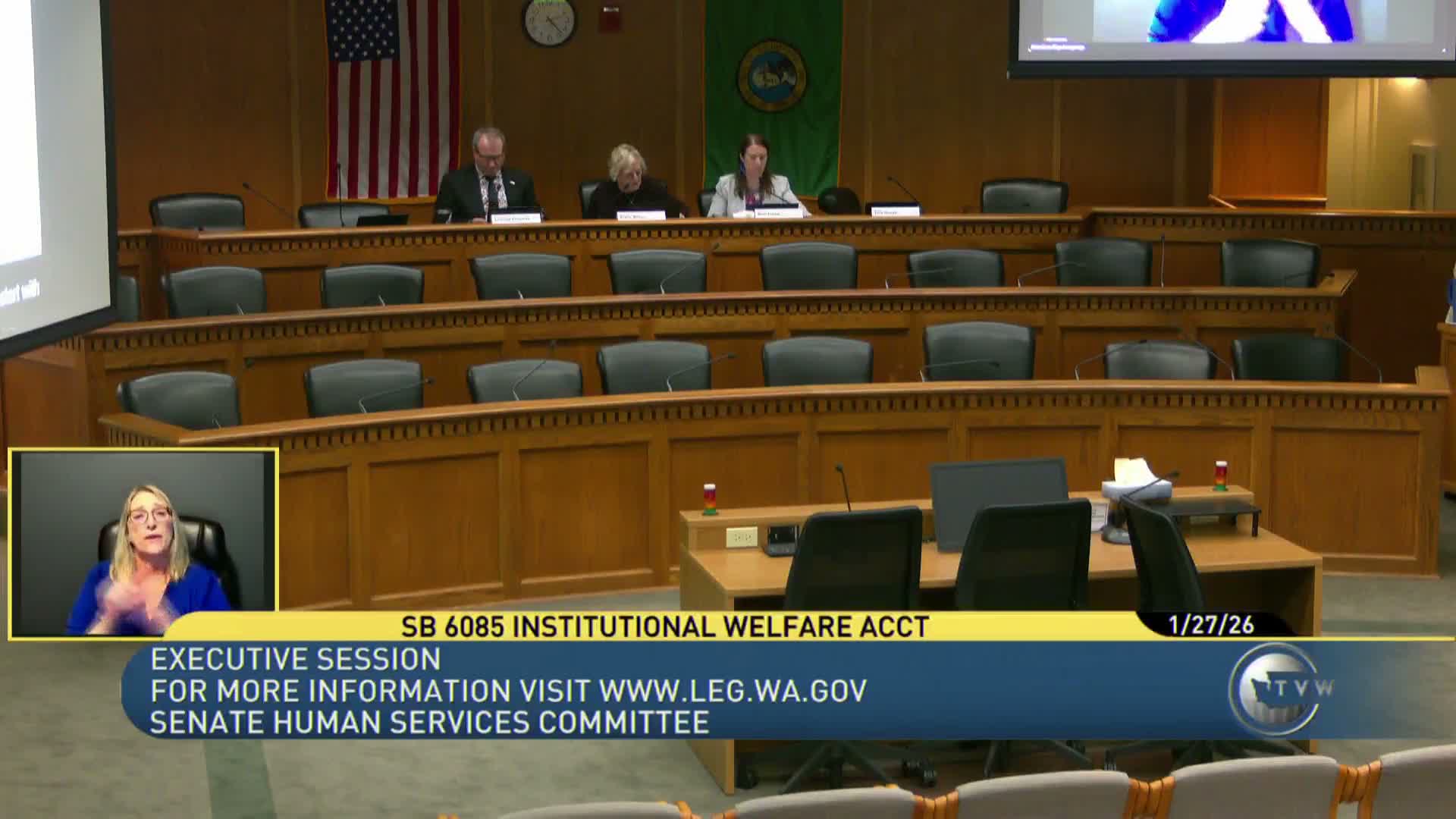
SB 6085 (institutional welfare account): The committee adopted amendment E1 (restoring law-library expenditures) and debated further amendments from Senator Christian on transparency, audits, custody restrictions, prohibitions on obscene materials, fund transfers to victims and other changes; most of those additional amendments failed. The proposed substitute was rolled and the bill received a due-pass recommendation and was sent to Ways & Means; the bill passed subject to signatures.
Throughout the session Senator Christian frequently framed amendment proposals around transparency, fiscal accountability and victim support; most of those amendments were rejected by the committee after debate. Multiple chairs and staff clarified where statutory authority or existing procedures already address issues raised (for example, state audit authority and existing DOC protocols were cited).
The committee concluded its executive session and adjourned with several bills advanced for further legislative consideration; the transcript records outcomes as "passed subject to signatures" or recommended to Ways & Means/Rules where noted.
AI generated
The text on this page is AI generated. Summaries, highlights, analysis, and video transcripts are all produced from the original source material.
AI can make mistakes, so if you spot one, and we will fix it for everyone.
Note: the source content is unaltered by us. Any content source we link to, be it a video, an audio recording, or a document, is presented exactly as its publisher released it. That publisher is usually a government body, sometimes an individual official or another organisation.