Lifetime Citizen Portal Access — AI Briefings, Alerts & Unlimited Follows
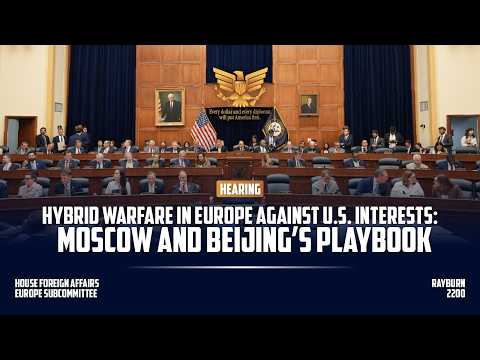
House Subcommittee on Europe hearing says Russian, Chinese 'hybrid warfare' is eroding transatlantic security
Loading...
Summary
Witnesses told a House subcommittee that Russia and China use a mix of kinetic and nonkinetic tactics across Europe—cyberattacks, sabotage, information operations and economic coercion—and urged the U.S. to help allies harden infrastructure, reduce dependencies, and raise costs for malign actors.
A House subcommittee on Europe heard testimony that Russia and China are conducting a sustained campaign of hybrid warfare across the continent that combines cyberattacks, sabotage, economic coercion and information operations to erode allied cohesion and influence decisionmaking.
"Ladies and gentlemen, we are at war," Chairman Self told the panel in his opening statement, framing the threats as a new age of ‘‘fifth-generation’’ conflict in which drone incursions, weaponized migration, the sabotage of railways and undersea cables, and cyber intrusions blur the line between peace and armed conflict.
Witnesses gave concrete examples and policy recommendations. Craig Singleton of the Foundation for Defense of Democracies said Beijing pursues penetration, prepositioning and pressure—embedding firms in ports, telecoms and supply chains to create leverage—and urged the United States to treat Chinese activity in Europe as a frontline challenge, help allies derisk dangerous dependencies and raise the costs for coercive behavior through targeted sanctions and public reporting. "Dependencies turn all of these commercial footholds into leverage," Singleton said.
Christopher Walker of the Center for European Policy Analysis described Russia's approach as "shadow warfare," a campaign that uses deniable operations and covert influence to degrade adversaries without provoking conventional retaliation. Walker cited CEPA's report War Without End and recommended strengthening transatlantic resilience, countering covert influence and reinforcing NATO cohesion.
Laura Cooper, a former Pentagon official, told the committee that "well over 100 acts of sabotage and attempted attacks in Europe since 2022" have included damage to railway lines, cyberattacks with physical consequences, warehouse explosions and assassination attempts. Cooper urged tougher sanctions enforcement, enhanced NATO posture on the eastern flank and a coordinated allied playbook for hybrid threats.
Members pressed witnesses on specific risks and policy options. Representatives raised concerns about undersea infrastructure, the role of commercial technology and artificial intelligence, and how social platforms are being exploited for information operations. Singleton said TikTok is a "key platform for the Chinese Communist Party to influence views in the United States" and flagged unanswered questions about the scope of any divestiture deal. Keating and others noted the recent decision cited in testimony to approve exports of advanced NVIDIA H200 chips to China as an example of policy choices that may complicate U.S. leverage.
On undersea threats, Cooper recommended steps to disrupt what she called Russia's "shadow fleet"—measures to target ship flags, administrative support and to improve allied intelligence and tracking of suspicious activity near cables and pipelines. Witnesses repeatedly urged stronger allied information-sharing and pre-agreed response mechanisms to avoid reactive gaps when incidents occur.
The hearing underscored a common theme: witnesses and members said the hybrid threat is multi-dimensional and requires both resilience-building and tools that impose costs on malign actors while preserving democratic freedoms. The subcommittee concluded the public portion of the hearing after taking testimony and signaled additional, classified briefings and written questions would follow.