Get email alerts on the Climate Resilience topic
No spam. Unsubscribe anytime.
Decatur updates climate resilience plan, cites expanded sensor data and community programs
Summary
City staff and Agnes Scott College reported progress on Decatur's Climate Resilience Plan: 17 items in progress and 10 completed, expanded heat‑sensor network showing extreme heat hotspots, revived CERT training, and new resident guides and partnerships to target flood and heat risk.
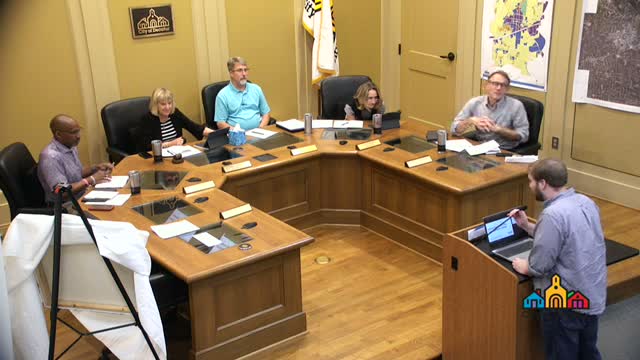
Decatur city staff and partners on May 19 delivered a progress report on the city's Climate Resilience Plan, highlighting new local data and community programs they say will guide future investments.
"We are now up to 17 action items that are currently in progress and 10 action items that have been completed," David Nifong, Decatur's energy and sustainability manager, told the commission. He said the plan focuses on adapting emergency management, developing policy and programs, and connecting residents with actionable resources.
Staff described a growing network of heat and humidity sensors deployed across the city and a planned collaboration with the Atlanta Regional Commission to develop a digital twin model to test mitigation strategies. Nifong said a sensor at the Dana Fine Arts Center recorded a heat index high of 114'F, a reading he described as "well above the 105 degree threshold where it does start to be very serious and have health impacts on the city." Another sensor at Webster recorded a top heat index of 99'F.
The presentation included seasonal trend data: 84 days with a heat index above 90 in 2023 and 110 days last year, figures staff said demonstrate more frequent and longer heat waves and implications for emergency response planning.
Staff also outlined resident-facing materials under development, including a post‑incident guide and a resilient landscape guide due in late 2025, and said Agnes Scott students are helping produce monthly outreach pieces for Decatur Focus to inform neighborhoods.
Public safety and volunteer programs are part of the implementation push. Fire Captain Gary Menard completed a CERT (Community Emergency Response Team) instructor certification, and staff plan to offer adult and teen CERT training, with the goal of building a network of volunteers to assist during incidents.
Nifong and partners explained how city and college research efforts'from heat sensors to water‑quantity monitors on Sugar Creek'are intended to feed capital project prioritization, grant applications and outreach. The presenters said an anticipated FEMA BRIC application was unavailable this year but stressed the data will be used to pursue other funding sources.
The commission asked staff to continue community engagement around canopy conservation and homeowner insurance pressures that could drive tree removal, and to return with more detail on how sensor and mapping results will steer capital investments.
AI generated
The text on this page is AI generated. Summaries, highlights, analysis, and video transcripts are all produced from the original source material.
AI can make mistakes, so if you spot one, and we will fix it for everyone.
Note: the source content is unaltered by us. Any content source we link to, be it a video, an audio recording, or a document, is presented exactly as its publisher released it. That publisher is usually a government body, sometimes an individual official or another organisation.