Get Full Government Meeting Transcripts, Videos, & Alerts Forever!
Get email alerts on the Forced Labor And State Incentives topic
No spam. Unsubscribe anytime.
House committee advances bill to bar state incentives for companies on UFLPA entity list
Summary
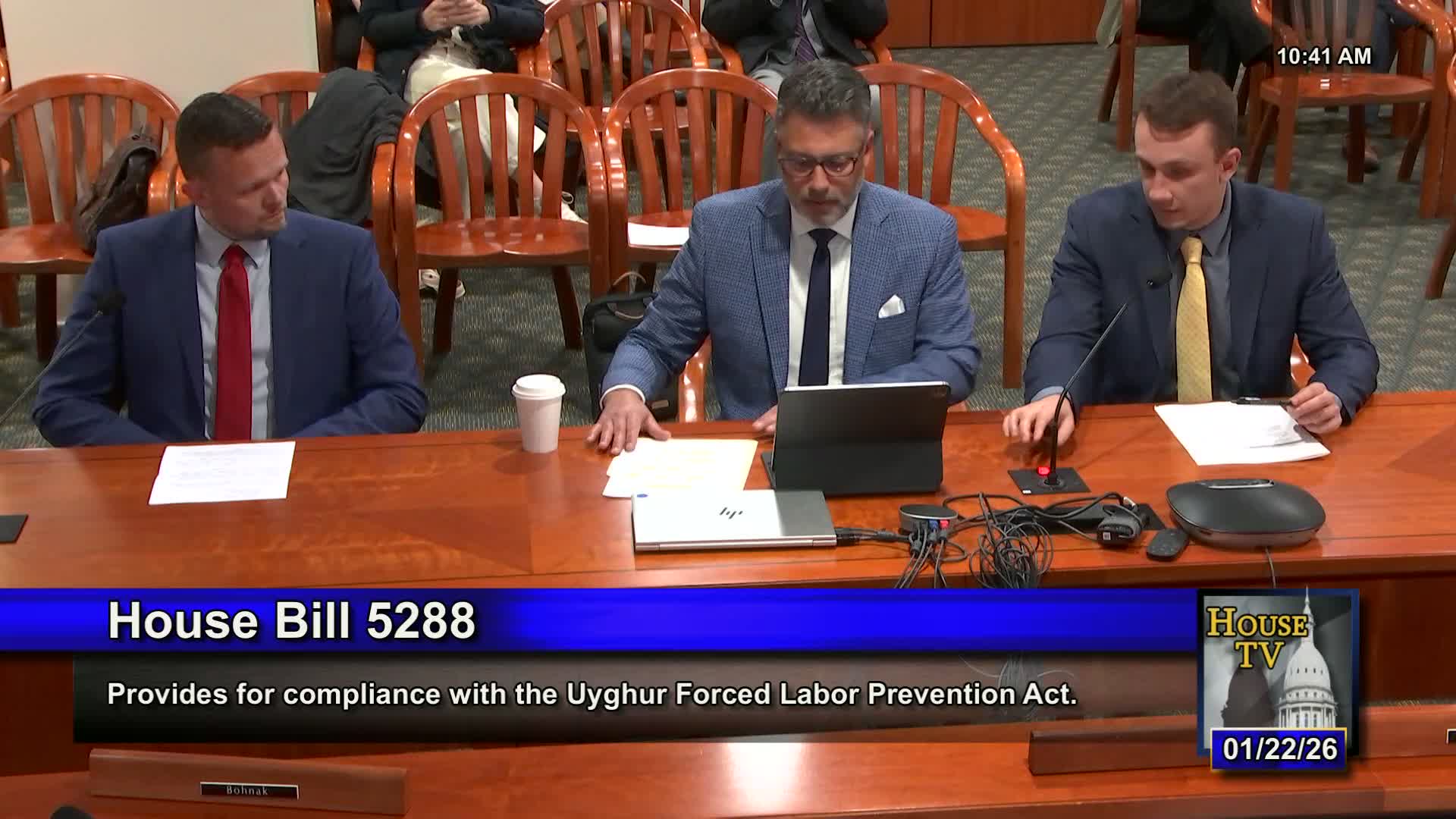
After testimony from human-rights and economic-policy witnesses, the House Committee on Economic Competitiveness voted to report House Bill 5,288 with recommendation. The bill would tie Michigan economic incentives to compliance with the federal Uyghur Forced Labor Prevention Act and require clawbacks for violations.
House Bill 5,288, which would prohibit the state from providing economic development incentives to companies that appear on the federal Uyghur Forced Labor Prevention Act (UFLPA) entity list, was reported with recommendation by the House Committee on Economic Competitiveness after a day of testimony and roll-call votes.
Supporters told the committee the bill aligns state policy with federal enforcement and protects taxpayers. Garrett Medina, chief of staff to Majority Floor Leader Posthumus, testified the bill "would amend the Michigan strategic fund framework to require compliance with the Uyghur Forced Labor Prevention Act" and that it "includes mechanisms for clawing back incentives when violations are identified." Jared Rodriguez, cofounder of the nonprofit Free Human Project, said the measure would prevent Michigan incentives from subsidizing companies tied to forced labor and noted the bill would apply to both new and existing agreements.
The bill's text, as described to the committee, would bar the state from entering into new or amended economic-development agreements with companies that appear on the UFLPA entity list maintained by federal authorities; it would also require repayment of incentives if a company is later added to the list. Rodriguez cited a global forced-labor estimate of about $236 billion annually to underline the scope of the problem and urged the committee to adopt the bill.
John Mosena, president of the Center for Economic Accountability, also supported the bill and referenced controversy over the Goshen project, saying opposition to that specific project "was rooted not in racism, but rather in valid concerns about the role the People's Republic of China would play in our state and in our communities." Mosena urged elected officials to decline subsidizing companies identified as benefiting from forced labor.
Committee members asked how state action would interact with federal law and how enforcement would work in practice. Witnesses said HB 5,288 does not create new federal standards but aligns state incentives with federal enforcement, provides clarity to businesses, and includes clawback and penalty provisions intended to protect taxpayers. Committee members also asked for follow-up information about the current size and composition of the UFLPA entity list; witnesses offered to provide updated numbers after the hearing.
The committee considered, and rejected, an H-2 substitute for HB 5,288 on a roll call that recorded three ayes and seven nays. After that vote, Representative DeBoer moved to report HB 5,288 with recommendation; the motion prevailed by roll call and the bill was reported out of committee.
The committee posted a letter of support submitted by Congressman John Moolinear to its website.
The committee is expected to forward the reported bill for further consideration according to the legislative process.