Get AI Briefings, Transcripts & Alerts on Local & National Government Meetings — Forever.
Senate panel adopts building security policy, including weapons screening and a limited firearms ban
Summary
The Rules and Administration Committee adopted a new Senate policy (8.5) to ban firearms and dangerous weapons in the Minnesota Senate building, establish weapons screening at designated entrances, and allow limited exceptions for permit-holders; funding, operational details and privacy for permit verification remain under discussion.
The Rules and Administration Committee on Jan. 30 adopted a new Senate policy, numbered 8.5, that bans firearms and other dangerous weapons from the Minnesota Senate building while establishing screening at entrances designated by the Rules Committee chair.
Lexi Stangel, counsel to the committee, said the purpose of the policy is “to keep visitors, senators, and staff safe and secure while in the building.” She told members the policy bans firearms and other dangerous weapons in the Minnesota Senate building but exempts people who carry a pistol under a permit to carry statute cited in the draft.
Stangel described operational elements: screening at one or more entrances chosen by the chair, additional guidance to be consistent with state law, and a committee-level ability to temporarily suspend the policy “if funding is not available or for other good cause.” She said the chair cannot unilaterally change the core ban or its permit-holder exception but can designate which entrances will be screened and set day-to-day procedures.
Committee members pressed for implementation details. Secretary Tom Boddern said equipment purchases could be paid from carry-forward accounts while staffing would come from the Senate’s general fund appropriation; exact dollar figures were not provided to the committee. Boddern said the contracted screening system identified in committee materials is produced by a company called Evolve and described the contract as “just slightly a few thousand more than a 100,000,” payable in four annual installments.
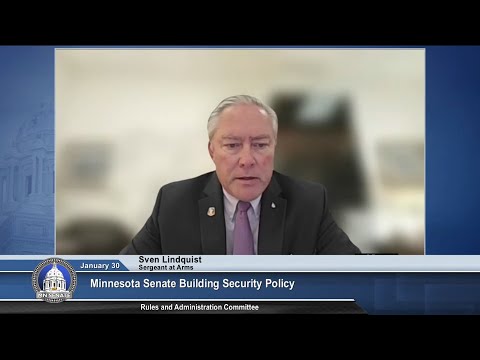
Sergeant Lindquist, who has been reviewing deployment options, told the committee that the principal company does not typically provide short-term leases and that one lease quote for roughly 120 days was nearly equal to the purchase price, which informed a recommendation that the multi-year purchase arrangement was more practical.
Members also raised privacy and access concerns. Senator Limmer warned that asking permit-holders to present carry permits in public could disclose private information about concealed-carry holders and create safety risks for those individuals; Stangel and Sergeant Lindquist said troopers assigned to screening stations would privately verify permits when someone declares a firearm or when a metal detector indicates a weapon.
Senator Marty described the policy as “a good step forward” but cautioned it was only one part of a larger security approach. After discussion, Senator Pappas moved adoption of the Senate building security policy; following a voice vote the chair declared the motion adopted.
The committee did not record a full roll-call tally for this voice vote in the transcript. Committee members asked staff to continue refining implementation details for funding, staffing levels (the committee discussed a minimum of three staff per screening point), and procedures for accommodating visitors with disabilities and other entrances such as garage access.
The committee’s action adopts the policy language as presented; the chair and staff will follow up on procedural guidance, budgeting and operations for weapons screening.