Lifetime Citizen Portal Access — AI Briefings, Alerts & Unlimited Follows
Panel: Threats to Judges Have Risen Sharply; Courts Urged to Improve Practical Protections
Loading...
Summary
Judges and security experts at a Seattle symposium told peers that threats to federal and state judges have climbed in recent years, with U.S. Marshals complaints rising from about 224 in 2021 to several hundred in later years; speakers urged better data collection, local security upgrades and coordinated public education.
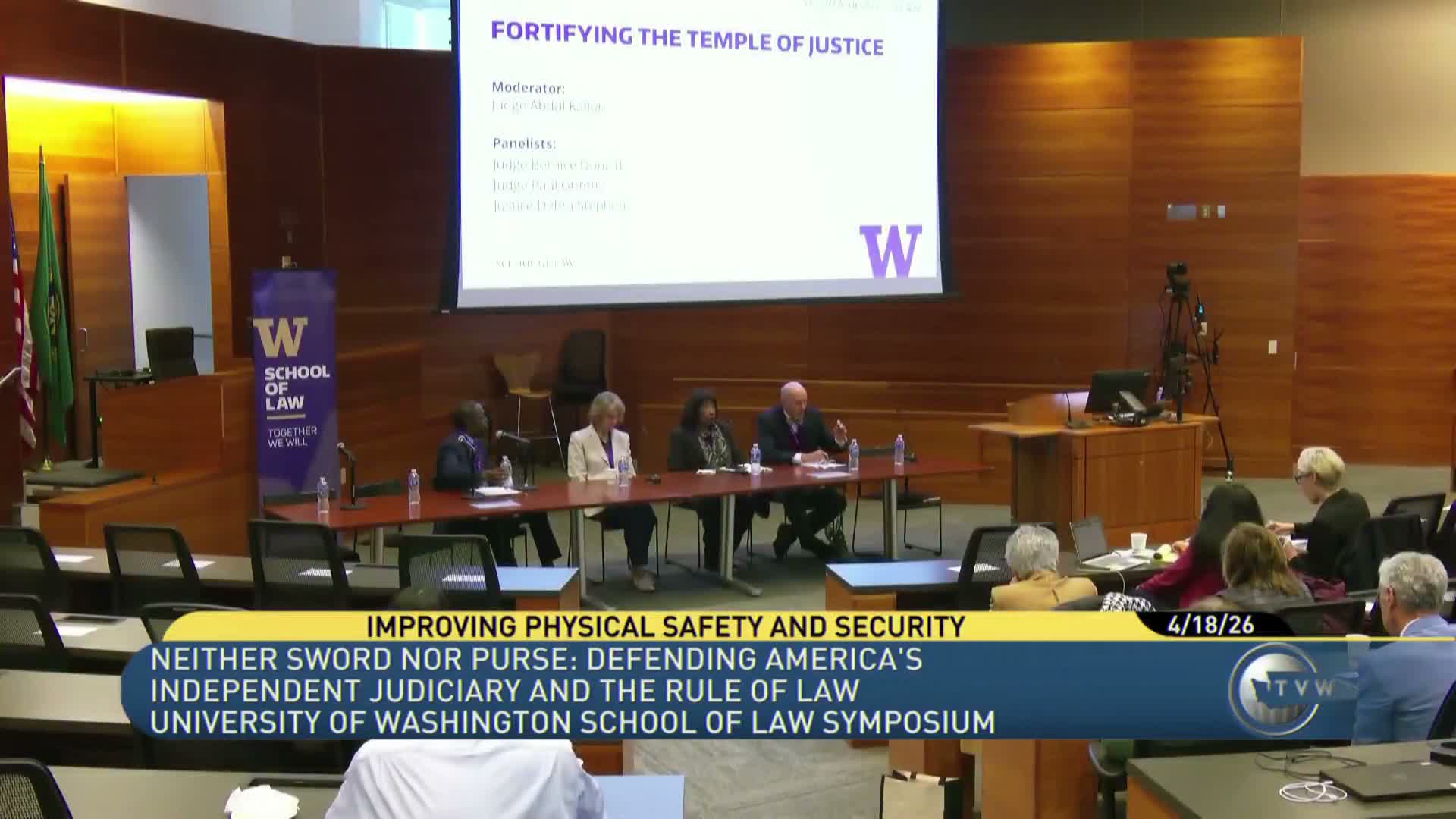
At a University of Washington symposium on threats to the judiciary, panelists from both the federal and state benches warned that threats to judges and their families have increased markedly, and urged practical, near-term steps to protect court personnel and facilities.
A judge speaking on the panel summarized U.S. Marshals Service review counts, saying, “The numbers in 2021, there were about 224” and then noting later totals “403” for 2022, “630” for 2023, “509” for 2024 and “564” for 2025; for fiscal 2026 the judge reported “256 so far.” He added that the Marshal's categories distinguish credible from serious threats and that about “396 unique judges” have been affected out of roughly 650–700 U.S. district judges, underscoring the breadth of the problem.
The symposium mixed statistical briefing, personal testimony and practical proposals. Retired judges who spoke for the Article 3 Coalition described outreach to media, commerce and civic groups to explain that judicial independence is a nonpartisan institutional concern and that retired judges have more latitude to educate publicly. “We are aggressively trying to make the case that this is not a partisan issue,” one retired judge said, urging collaboration with business and media partners.
State-court representatives pressed for improved data collection and modest, targeted funding. The state chief justice described a recent internal decision to reimburse home-security measures and add perimeter screening and said many state courthouses remain in historic buildings without modern entry controls. “We have to invest in whether it's hired folks or contracted folks, people who have excellent training and will give us guidance on how to assess threats,” she said.
Panelists recounted concrete manifestations of the threat environment: doxing campaigns, threats aimed at family members and online disinformation that can be amplified quickly. A sitting judge described a case in which a voicemail threatened a judge’s daughter by name; another judge described finding weapons in a courthouse vending area after-hours. Panelists stressed that responses must be calibrated—many incidents warrant monitoring and assessment, while others require immediate protective details.
The group debated the practical effect of recent guidance on judicial speech (an ethics advisory the panel referenced as Opinion 118). Several speakers said the opinion clarifies when sitting judges must remain silent about particular cases but will not be a “sea change” in judge behavior. Retired judges and bar groups were positioned as important voices who can speak publicly without the same constraints.
Panelists recommended specific steps courts can take now: establish or expand court public-information offices to provide timely, accurate summaries; create routine, low-cost perimeter and building improvements (screening, controlled elevators, check-in stations); adopt automated reporting systems for odd emails or online posts so security professionals can triage risk; and expand training on digital threats including AI-driven deepfakes.
The panel closed with a call for better coordination between federal and state systems and for more robust data collection so policymakers can target resources where judges and staff are most vulnerable. Absent new centralized state-level data, participants said, many state courts remain effectively invisible in national statistics and therefore under-resourced.
The symposium’s next steps included work by the Article 3 Coalition and state chief-justice groups to pilot local reporting and communications tools and to press for modest budget allocations for physical upgrades in vulnerable courthouses.