Get Full Government Meeting Transcripts, Videos, & Alerts Forever!
Get email alerts on the HB2384 topic
No spam. Unsubscribe anytime.
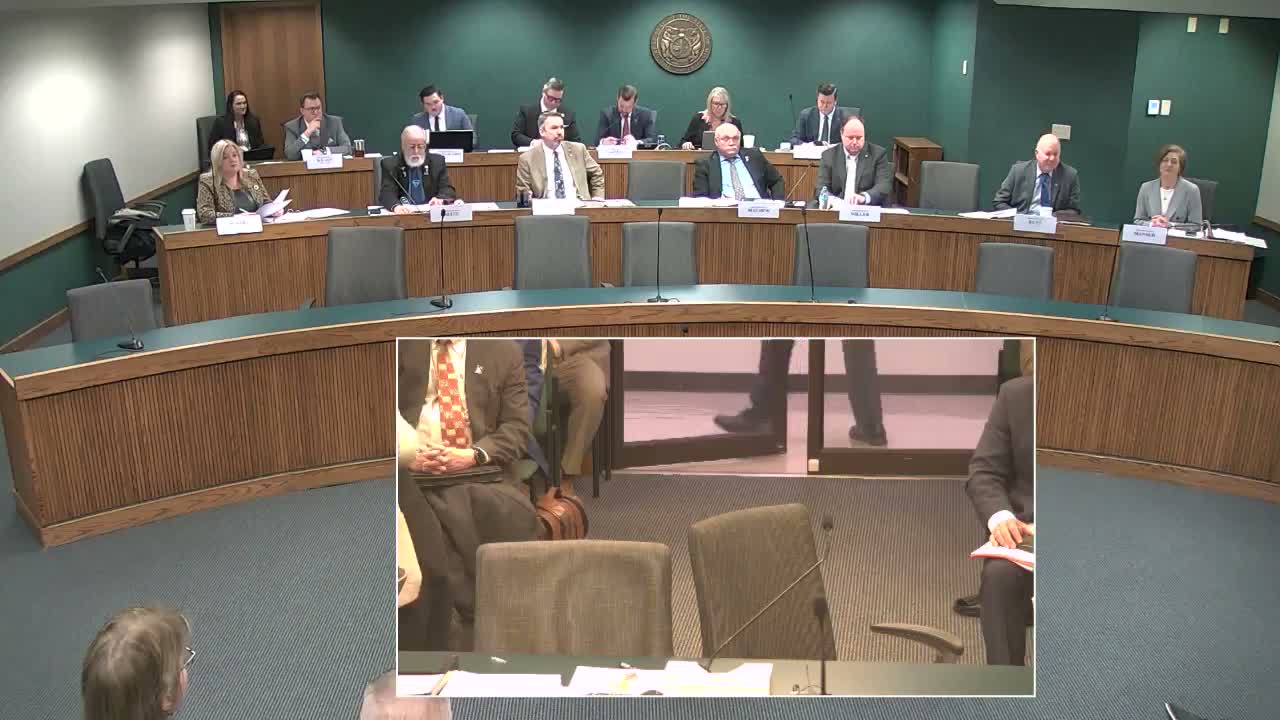
Commerce Committee hears hours of debate over HB 2,384: builders urge relief; code experts warn of long-term costs
Summary
House Bill 2,384, sponsored by Rep. Mike Jones, drew hours of testimony on whether capping energy codes at 2009, adding permitting deadlines and allowing single-stair multifamily buildings will reduce housing costs or raise long-term bills and public-safety risks. Supporters — home builders and developers — said the measures will unlock production; code experts, architects and Kansas City officials warned of higher lifetime energy costs, lost regional coordination and threats to local control.
The Missouri House Commerce Committee heard more than three hours of public testimony on House Bill 2,384, a multifaceted housing bill sponsored by Representative Mike Jones that would limit certain energy-code requirements, create permitting timelines and allow some multifamily buildings to be constructed with a single staircase under defined safety standards.
Jones, the bill’s sponsor, opened the hearing by calling the housing shortage a statewide crisis, saying Missouri faces a deficit of roughly 115,000 housing units and that regulatory costs — including energy mandates — are inflating new-home prices. "Regulation compliance already accounts for nearly 25% of the cost of a newly built home," Jones said, and argued that mandates can add "up to $30,000 to the cost of a home without improving basic safety." He said the bill’s three-pronged approach — rolling back excessive energy requirements, imposing permitting timelines and allowing a single-stair option for some multifamily buildings — would produce more housing and make homeownership more achievable.
The hearing quickly split along familiar lines: local governments, building-code experts, architects and energy-effectiveness advocates urged caution. Kurt Reich, president and CEO of the North American Insulation Manufacturers Association, told the committee the Energy Code (IECC) updates produce lifecycle savings that outweigh modest first costs. "Homeowners come out on top when you embrace the 2012 code," Reich said, citing DOE analyses that found multi-decade paybacks and lower utility bills for homeowners. Amy Schmidt of the Energy Efficient Codes Coalition warned that a statewide rollback to a 2009 energy baseline would increase energy burdens on consumers and rid the state of benefits such as improved durability and reduced moisture risk.
Kansas City representatives and other municipal officials urged the panel to respect local deliberations. Shannon Cooper, representing the City of Kansas City, said the code-adoption process there was deliberate and reflective of urban needs; she argued a statewide ceiling would undercut local voters’ choices. "These codes and these energy standards were based on what our elected officials… decided to do," Cooper said, adding that the city opposed an external cap that would prevent upward local standards.
Home builders and developers testified that the combination of measures in HB 2384 is necessary to keep projects and jobs in Missouri. Builder Sean Woods described a direct comparison in Kansas City: "The energy-rated house cost $12,000 more" to meet more recent code standards and yielded a relatively small annual savings; Woods said higher up-front costs pushed projects across the state line. Will Reuter of the Home Builders Association cited recent migration of development to the Kansas side of the metro and warned that cumulative code costs squeeze marginal projects and small, local developers.
Technical witnesses from ASHRAE, AIA and other code bodies pushed back on the numeric claims. David Herron, who serves on ASHRAE committees, said the Department of Energy and peer-reviewed studies show energy-code upgrades provide measurable lifecycle savings; he cited DOE/PNNL analyses that estimate the energy improvement portion of code upgrades at roughly $7,000 (not $30,000) with significant long-term savings in utility costs and resilience.
Committee members asked witnesses to reconcile competing cost estimates and to clarify the bill’s scope. Jones and supporters repeatedly stressed that the bill would not impose a statewide mandatory building code but would cap energy provisions at the 2009 IECC for municipalities that choose to opt into a code. Opponents argued that the bill reads as a ceiling and would limit local officials’ ability to tailor codes for urban safety and climate needs unless the language were made explicit that the 2009 standard functions only as a minimum base rather than a cap.
Architects also warned that the single-stair provision lacks safety details present in other states’ models. Laura Pastine of AIA Missouri noted that other states that permit single-stair designs include explicit compensating measures — two-hour rated stairways or mandatory sprinklers — that are not spelled out in HB 2384 and should be if the committee adopts the change.
The committee did not vote on HB 2,384 at the hearing. Members requested additional data on cost comparisons and evidence about permitting delays, and committee staff indicated they would collect studies and reports from both proponents and opponents. The bill remains under consideration as lawmakers weigh immediate affordability pressures against long-term lifecycle costs and local control concerns.