Get AI Briefings, Transcripts & Alerts on Local & National Government Meetings — Forever.
Senate Judiciary Committee holds first hearing on bill to limit banks’ use of firearm merchant data
Summary
On Jan. 23 the Alaska Senate Judiciary Committee heard SB 136 (Cronk), which would bar financial institutions and payment networks from discriminating against lawful firearm transactions and from keeping certain firearm registries; the committee held the bill for further review amid questions on public‑safety exemptions, court‑rule changes and attorney‑fee language.
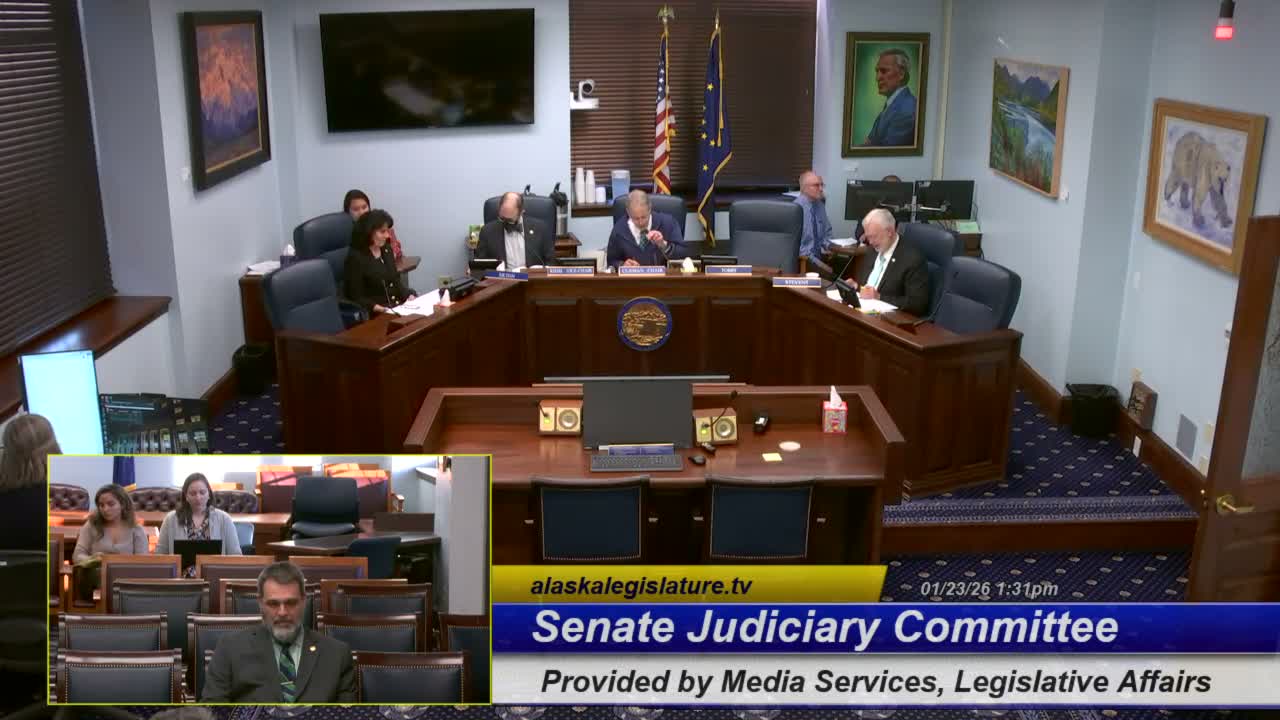
Juneau — The Alaska Senate Judiciary Committee held its first hearing on Senate Bill 136 on Jan. 23, a measure sponsored by Sen. Mike Cronk that would restrict how financial institutions and payment networks treat and disclose data tied to firearm transactions.
Paul Menke, staff to Sen. Cronk, told the committee the bill is “relating to the privacy of firearm transactions” and seeks to prevent banks and card networks from declining lawful firearm purchases, charging higher interchange fees for them, or otherwise using merchant codes to throttle lawful commerce. Menke cited incidents in Alaska and the Lower 48 and described one small‑business example in which a $10,000 charge was declined; he said the merchant later recovered the amount with help from a federal senator’s office.
The bill would add a new provision to AS 6.90.020 forbidding financial institutions and payment networks from declining or limiting lawful firearm transactions or imposing higher fees for them. It would add AS 44.99.515 to prohibit, with limited exceptions, keeping lists or registries of privately owned firearms or firearm owners. Menke told the committee the bill authorizes the attorney general to investigate alleged violations and allows the court to award up to $10,000 for knowing violations; the statute also would obligate courts to award reasonable attorney fees and other remedies to a prevailing petitioner or the attorney general.
Nancy Mead, general counsel for the Alaska court system, told senators the bill also contains two indirect court‑rule changes. She explained the measure would delay the immediate effect of certain injunctions for 30 days if the statute so provides and would alter Rule 82 consequences so that a prevailing petitioner could recover full reasonable attorney fees in these causes of action.
Committee members pressed staff on several policy and drafting details. Sen. Lora Tobin raised public‑safety concerns related to domestic‑violence shelters and school records; Menke said drafters were preparing an amendment to narrow the prohibition so it would not bar shelters from keeping internal lists and that routine law‑enforcement records kept during criminal investigations remain exempt. Tobin also asked whether merchant category codes are used by law enforcement to detect suspicious bulk purchases; Menke said the office had not yet consulted law enforcement and offered to do so.
Vice Chair Sen. Kiel asked whether the bill would inadvertently block ordinary rewards, points or co‑branded discounts; Menke said payment networks typically record a transaction identifier and an amount rather than an itemized purchase list but committed to follow up with a written clarification. Sen. Kim raised similar concerns about opt‑in vendor discounts on co‑branded cards.
Sen. Keogh and others questioned the bill’s provision that would require courts to award full reasonable attorney fees to a prevailing petitioner or the attorney general. Menke said the provision, as drafted, appeared one‑way; senators worried that a one‑way fee award could create an incentive to bring suits. Mead said she did not have data showing whether full‑fee statutes produce that effect and would research precedents.
Menke told senators his office had met with industry representatives, including Yuri Morgan of the Alaska Bankers and Scott Talbot of the Electronic Transactions Association; he said bankers had raised concerns but did not file a final position letter and the ETA contact told staff the association was neutral in meetings while expressing resistance to requiring unique merchant codes by industry.
Sen. Tilton disclosed he carried the companion House bill and that the constituent Menke described, Donna Anthony, is his constituent; he confirmed Anthony’s disputed $10,000 charge was ultimately credited.
After questions and discussion, Chair Sen. Clayman said the committee would hold the bill for further review. No vote was taken. The committee adjourned at 2:06 p.m. and scheduled its next meeting for Jan. 28 at 1:30 p.m.
What’s next: Committee staff said they will provide follow‑up clarifications on definitions (including whether 'loaded' ammunition is covered), on whether co‑branded rewards are affected, on the attorney‑fee drafting and whether the one‑way fee language should be modified, and on outreach to law enforcement and financial‑industry stakeholders.