Lifetime Citizen Portal Access — AI Briefings, Alerts & Unlimited Follows
Reynolds outlines property tax caps, veterans overhaul and rural health funding in 2026 State of the State
Loading...
Summary
Gov. Kim Reynolds told a joint convention that the state is "strong" and proposed a package to cap local revenue growth, shift property assessments, freeze bills for many seniors, expand veterans benefits, invest federal rural health dollars in cancer prevention and create technology partnerships to modernize state systems.
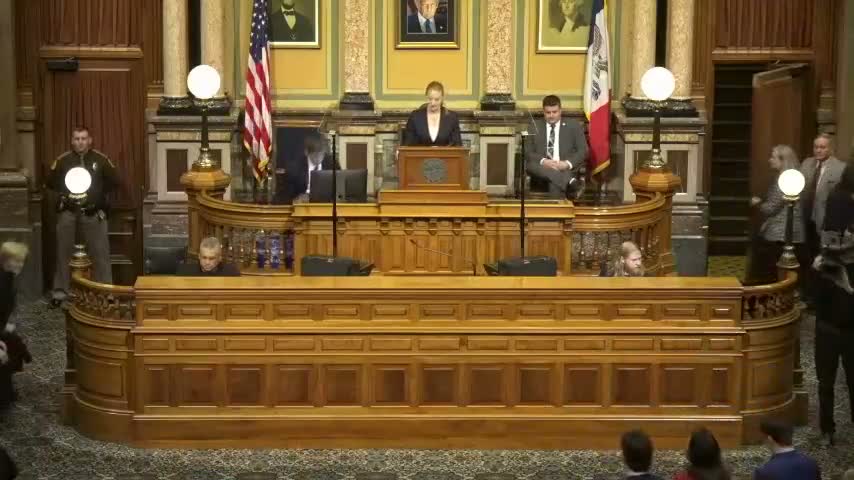
DES MOINES — Gov. Kim Reynolds delivered the 2026 State of the State to a joint convention of the General Assembly, outlining proposals to cap local revenue growth, change how property taxes are assessed, expand veterans’ benefits and invest federal rural health funds in cancer prevention and treatment.
Reynolds opened with memorials for recent lawmakers and names of Iowa service members killed in an overseas attack, then laid out legislative priorities she said are aimed at reducing costs for families and modernizing state services. "As I've declared every time I've been at this podium, the condition of our state is strong," she said.
Why it matters: Reynolds framed rising property taxes as the immediate pain point for many residents and proposed a legislative package that would cap overall revenue growth for local governments, move property tax assessments from every two years to every three and shift the burden onto assessors to justify large increases. "I'm introducing a property tax bill that will cap overall revenue growth for local governments," she said, adding the changes are intended to prevent government from "grow[ing] faster than the families who pay the bills."
Major proposals and details
- Property taxes: Reynolds said property taxes have risen "more than 10%" over the last two years and proposed a cap on local revenue growth plus a move to three-year assessment cycles. She also proposed a targeted freeze: "freezes property tax bills for Iowans aged 65 and up whose homes are valued at 350,000 or less." The governor said the intent is to protect seniors on fixed incomes.
- Veterans: Pointing to what she described as low uptake of earned benefits, Reynolds said Iowa is "home to nearly a 178,000 veterans yet only a third is receiving the benefits they've earned" and proposed modernizing the county-level veterans compensation system together with a new performance-based county grant program to incentivize higher VA compensation per capita.
- Housing and farms: The governor proposed a tax-deductible savings account for first-time homebuyers modeled on an existing Iowa program and said she will modernize the beginning farmers tax credit by expanding its size, making it refundable and extending it to land sales as well as leases.
- Health and cancer prevention: Reynolds highlighted the Healthy Hometowns rural health plan, saying it was awarded $209,000,000 for year one of a federal rural health transformation grant and that more than $50,000,000 will be invested this year specifically in cancer prevention, screening and treatment ("and, we expect it to grow to a 183,000,000 over 4 years," she said). She described plans for cancer care hubs and satellite clinics to expand access in rural areas.
- Technology and operations: Reynolds announced partnerships with Amazon Web Services to consolidate state call centers and with Google Public Sector to build a modern child welfare system, calling the efforts a way to save money and accelerate service improvements.
- Nutrition and schools: The governor said Iowa will keep a "nutrition first" focus for SNAP and summer EBT, excluding candy and soft drinks, requires nutrition continuing education for physicians, and introduced a bill to remove artificial food dyes from school lunch programs. On K–12, she cited statewide gains in literacy, math and attendance and proposed per-pupil funding that follows the student while ensuring charter students access to concurrent enrollment and extracurricular activities.
What’s next: Reynolds presented these items as legislative proposals to be considered by the General Assembly; she did not present enacted bills or final appropriations during the address. Several items she announced — including the property tax cap, the veterans modernization and the SNAP waiver directive — would require legislative action or administrative steps to implement.
Votes at a glance (procedural actions recorded during the joint convention)
- Motion to dispense with roll call and authorize the president to declare a quorum present — moved by Senator Clemish; motion prevailed (chair announced motion prevails).
- Motion to appoint a six-member committee to notify Governor Kim Reynolds — moved by Senator Clemish; motion prevailed; committee announced (Senators Whitver, Gruenhagen, Dray; Representatives Gustoff, Weldon, Ramirez).
- Motion to dissolve the joint convention — moved by Representative Kauffman; motion prevailed and the convention was dissolved.
- Motion to adjourn the House until 8:30 a.m. Wednesday, Jan. 14 — moved by Representative Kaufman; the presiding officer put the motion and the House was adjourned.
Reporting notes and limits: The address presented multiple proposals; none were enacted on the floor during the joint convention. Where Reynolds cited numerical figures (for example, investment and funding totals and the share of veterans receiving benefits), those figures were stated during the address and are reported here as she presented them.
The speech concluded with Reynolds saying she will "finish strong" in what she described as her final legislative session as governor.