Get AI Briefings, Transcripts & Alerts on Local & National Government Meetings — Forever.
Committee hears divided testimony on SB 5932, which would clarify carbon‑intensity rules and tax triggers for sustainable aviation fuel
Summary
SB 5932 would clarify how electricity carbon intensity is calculated for sustainable aviation fuel (SAF) production and set a production or date trigger (20 million gallons or 07/01/2031) for preferential tax rates and credits; proponents sought certainty for a Moses Lake SAF plant while Ecology and climate groups warned the bill could weaken the Clean Fuels Program’s incentives for new renewable generation.
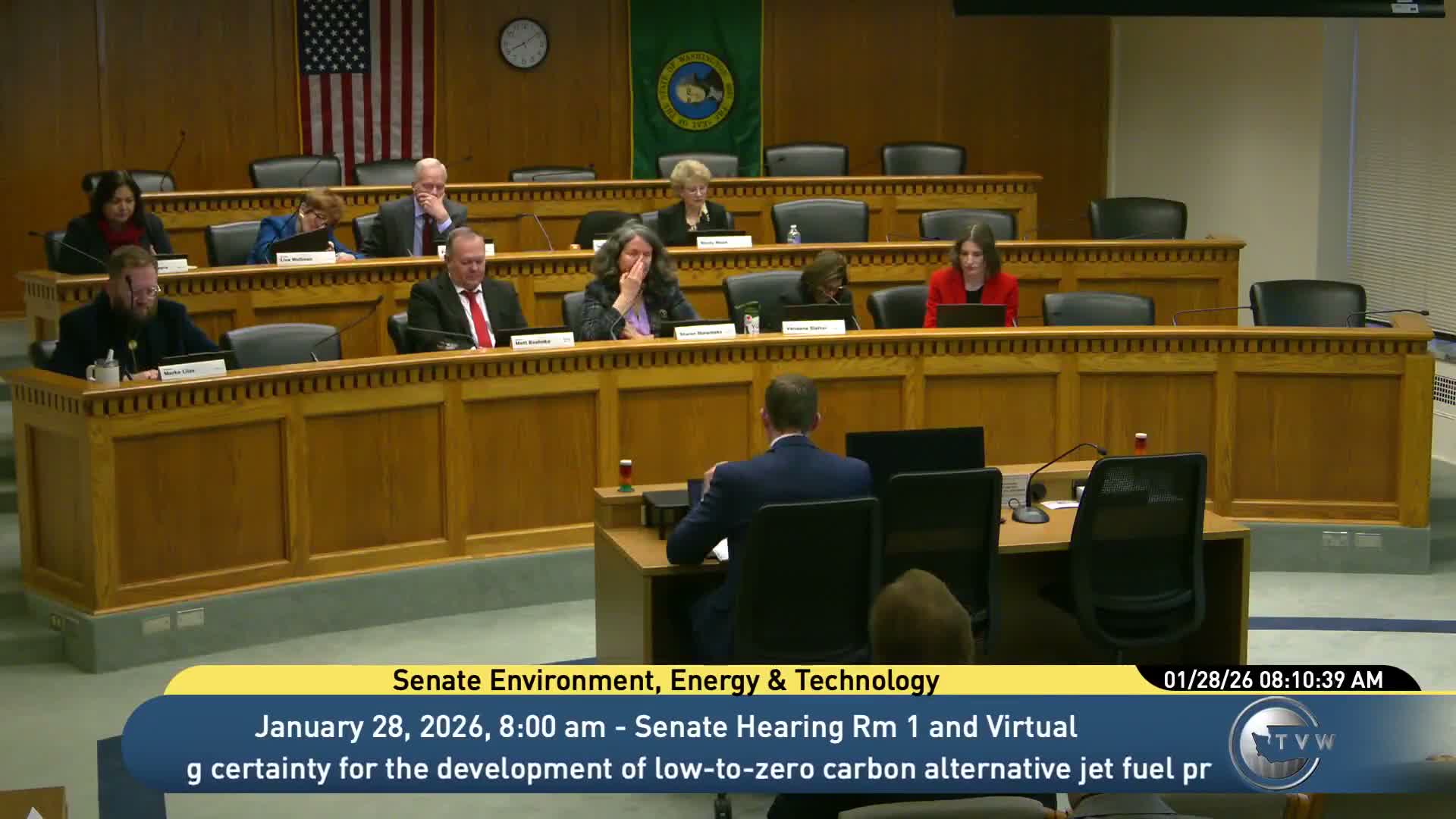
Senator Warnecke introduced SB 5932 and industry proponents said the bill is intended to provide certainty for emerging sustainable aviation fuel (SAF) producers in Washington.
Dave (company representative for the firm identified in the transcript as "Twelve") said the Moses Lake proof‑of‑concept facility is nearing production and that uncertainty around a 20,000,000‑gallon production threshold prevents expansion and investor due diligence. He told the committee the company has more than $3 billion in executed offtake contracts and that the fiscal note’s production timing assumptions are optimistic for most firms.
Joel Creswell of the Department of Ecology urged caution. He told the committee SB 5932 would allow certain SAF pathways to claim a 0‑carbon electricity intensity for production and could remove provisions that incentivize new renewable electricity. "SB 5,932 weakens the clean fuel standards ability to incentivize new renewable electricity generation," Creswell said, and he warned the change could limit incentives for electric‑vehicle adoption and EV charging deployment that are part of the Clean Fuels Program’s broader effects.
Climate advocates supported SAF production but opposed rule changes that would expand crediting for co‑products or allow resource shuffling. Leah Missick of Climate Solutions testified the bill “would expand the ability to claim credit for clean electricity used in the process to cover co‑products” and could result in fewer on‑road pollution reductions if credits shift away from compliance fuels. Industry and local officials, including Deputy Mayor Don Myers of Moses Lake, urged certainty to keep investment and jobs in state.
Witnesses including Sky Energy and US Oil-Pacific recommended careful drafting to preserve investment certainty while protecting the Clean Fuels Program’s environmental goals. Committee members asked Ecology for the technical comments the agency had shared with sponsors; Creswell said Ecology would provide its suggested changes and accommodate start‑ups where possible without undermining program integrity.
The committee closed public testimony and will consider technical amendments and the agency’s recommendations as the bill advances.