Get Full Government Meeting Transcripts, Videos, & Alerts Forever!
Get email alerts on the Fire Metrics topic
No spam. Unsubscribe anytime.
York County reviews fire metrics dashboard; volunteers and chiefs press to preserve apparatus identity
Summary
County staff showcased a new public-facing metrics dashboard for fire turnout and response times; discussion moved to station placement, second/third dispatch interpretation and a robust public comment exchange urged preserving local truck paint/identity and considered wraps vs. paint costs.
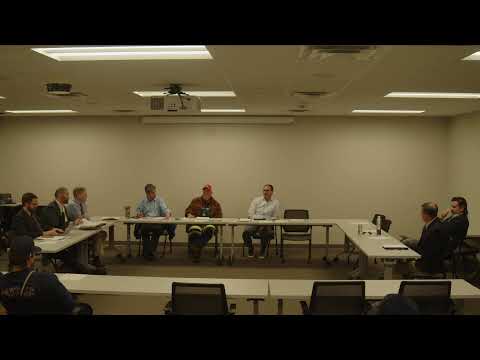
County fire staff briefed the Justice and Public Safety Committee on an updated, public-facing fire metrics dashboard and a range of departmental issues raised during public comment.
The dashboard, staff said, allows filtering by priority, department type (career, combination, volunteer) and time periods, and is updated monthly. "This shows your calls. You can even get down into the department metrics," the presenter said, describing turnout and response-time measures that the county plans to use for continuous improvement rather than punitive enforcement.
Committee members pressed staff on interpretation of second- and third-dispatch events and whether the dashboard differentiates low-consequence repeat dispatches from high-priority outliers. Staff explained dispatch behavior: if a first-dispatched unit is not available after about three minutes a second dispatch is issued and after roughly five minutes a third dispatch is sent; each plotted dot represents a single call and deeper RMS review is required to classify outliers.
Members and staff also discussed station placement, travel-distance standards and traffic’s effect on response times. Staff noted turnout standards differ for volunteer versus career departments and said the county will incorporate traffic and road-network data when evaluating distribution of stations and deployment of units.
A substantial public-comment block focused on apparatus identity and costs. Several chiefs and volunteers urged preserving two-tone paint schemes and department identity. One public speaker provided vendor estimates, saying painting a new engine two-tone can cost “between 3 and $5,000” (presenter estimate) and that specialty tankers or tank vehicles can be far more expensive; other commenters recommended wraps as an interim option to preserve local identity while allowing fleet rotation. Committee members and staff acknowledged the tradeoffs between pride/identity and countywide fleet efficiency.
What’s next: staff will continue to refine the dashboard, provide additional breakdowns (such as counts of two- vs. three-dispatch events), work with fire departments on budget and recruitment strategies, and follow up with tax-district leaders and the fire chiefs association on apparatus rotation and stipend questions.