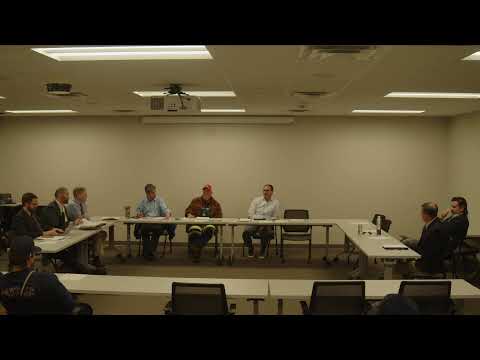
York County committee reviews draft EMS franchise ordinance to standardize ambulance oversight
Loading...
Summary
Committee reviewed a draft ordinance that would require county-issued franchises for all emergency transport providers, create oversight and a clinical quality-review body, and allow conditional six-month transition periods for existing providers before three-year franchise terms.
York County’s Justice and Public Safety Committee spent the bulk of its meeting discussing a proposed EMS franchise ordinance intended to create county-issued franchises for any ambulance service that provides emergency transport within the county.
County staff who presented the draft said the ordinance is designed to establish consistent authority, oversight and accountability across all EMS providers. “What we’re proposing through this ordinance is a franchise framework, but it establishes consistent authority, oversight, and particularly accountability across the entire county,” the presenter said. Staff emphasized the draft is preliminary and will be formatted by the county attorney before it is sent to full council.
Under the proposed framework, any ambulance service providing emergency transport in the county would be required to hold a franchise agreement with the county. Staff said the franchise would not automatically supersede existing contracts; instead, compliance with franchise terms would be treated as satisfying county transport agreements while giving the county an additional, uniform standard to enforce.
The presenter told the committee the ordinance would include guardrails to protect the 911 system from being weakened by nonemergency transports, noting that utilization practices by some providers can pull units away from 911 coverage. “One of the ways that in some areas that they ensure that number is driven up is by that downtime when they’re not on an emergent call, they’re running a non emergent call,” staff said, adding the ordinance would include language to protect 911 resources.
Two governance bodies were described in the draft: an operational oversight committee responsible for staffing, response-time standards and operational formulary; and a clinical quality-review committee (described by staff as similar to a medical-control board) that would review clinical outcomes such as door-to-call times, cardiac arrest survival rates and trauma-scene times. The medical review body, staff said, would be physician-led and would enable after-action reviews and protocol updates across providers.
Committee members asked how the franchise model would intersect with municipal and volunteer fire departments, and whether the ordinance would affect first-response capabilities. Staff replied the ordinance focuses on transport providers but is “absolutely” intertwined with first-response and that other strategic planning work will address how fire departments and posting plans integrate with the franchise model.
Members also raised questions about data and definitions. Presenters acknowledged the county currently dispatches many calls as emergencies but does not yet track how many of those convert to nonemergent transports on scene; they said upgrades to QA software and uniform data-reporting in the franchise would improve that tracking. Staff explained how emergency medical dispatch (EMD) protocols inform triage and that telehealth options may be possible in the future but would rely on EMD integration and further development.
On enforcement and terms, staff said franchises would be issued for initial three-year terms with three-year renewals. Existing providers would receive a conditional franchise for a six-month transition period, during which policies, applications and data requirements would be finalized. The county would gain enforcement mechanisms — including fines, probation or other penalties — for franchise noncompliance, staff said.
The presenter asked the committee for feedback; if the committee concurs, staff said the county attorney would format the ordinance into the county’s codified style and the committee could advance it for full-council consideration. The committee did not take a formal vote on the ordinance during the meeting; staff were directed to return with the formatted ordinance and any requested revisions.
What’s next: staff will incorporate committee feedback, finalize policy and application materials during the six-month transition period, stand up the oversight and quality-review bodies, and bring a formatted ordinance for the committee to consider advancing to full council.