Get Full Government Meeting Transcripts, Videos, & Alerts Forever!
Get email alerts on the State Legislation topic
No spam. Unsubscribe anytime.
Arizona House Democratic caucus reviews dozens of bills; members pull several from consent
Summary
House Democrats heard presentations on numerous measures — from election‑timing changes and water funding to contested abortion and parental‑rights bills — and pulled several items from the consent calendar for further review. One water grant measure (HB 2096) passed by unanimous voice vote.
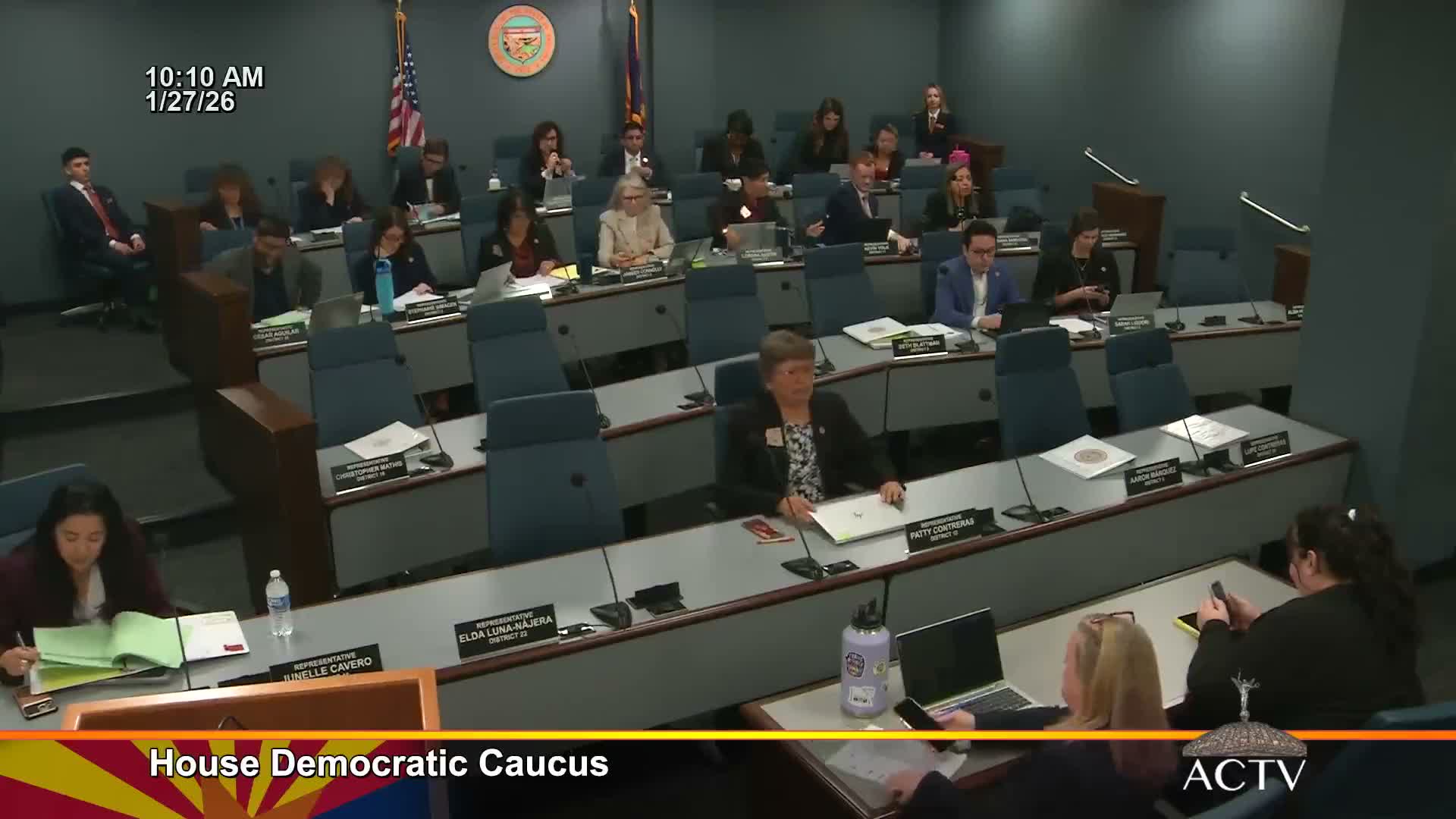
Members of the Arizona House Democratic caucus met to review the minority caucus consent calendar and to hear brief presentations on dozens of bills moving through the 2026 Legislature.
The meeting opened with chair remarks and introductions of pages and interns. Staff member Rhonda walked caucus members through consent‑calendar rules, explaining that third‑read consent bypasses a committee of the whole and that pulling a bill places it on the regular COW agenda and allows floor amendments. "If you want to amend a bill it's automatically gonna be pulled off if you circulate a floor amendment," Rhonda said during her explanation of procedures.
Lawmakers then ran a series of short presentations. Water and natural‑resource bills received sustained attention: Representative Vicente reported a package of measures that would allow water‑augmentation funds to support snowpack augmentation projects, require grant applicants to disclose projected water savings, and direct the Department of Water Resources to map potential stormwater recharge sites (HB 2053), which includes a $100,000 appropriation in fiscal 2027 for mapping. Vicente also described HB 2116, which would appropriate $1,000,000 from the state general fund to a Colorado River Litigation Fund to defend Lower Colorado River basin rights after 2026; staff clarified the governor’s separate $30 million resilience proposal serves different uses.
The caucus noted support and concerns for several bills affecting public health and criminal penalties. Celiana summarized HB 2074, a measure requiring medical‑facility employees, contractors or volunteers with knowledge of a so‑called "partial birth abortion" to report that knowledge to the county attorney; committee amendments upgraded failure‑to‑report penalties from a class 2 misdemeanor to a class 6 felony. Representative Garcia called the bill "yet another restriction of abortion that has no medical benefit and only seeks to impose barriers to abortion care." Director Mack provided sentencing information for a non‑dangerous class 6 felony, noting a presumptive term of about one year and a statutory maximum of 1.5 years.
Members also objected to bills they characterized as advancing so‑called "personhood" policies. Celiana presented HB 2043 (expanding first‑degree felony murder to include death of an unborn child) and HB 2144 (allowing a confirmed positive pregnancy test date to be used to calculate retroactive child support for a "preborn child"). Representative Garcia urged pulling those items from consent, citing voter rejection of similar measures at the ballot box in prior cycles.
A parental‑rights expansion (HB 2249) that would require notification and broaden access to minors' educational records — and that would allow civil suits against governmental entities for alleged violations — drew objections from members who described the bill as "anti‑student" and raised concerns about costs and civil‑liability exposure.
On criminal‑justice measures, Celiana summarized bills changing trafficking and enhanced‑sentencing thresholds (including a proposal that would lower the fentanyl threshold for enhanced sentencing from 200 grams to 100 grams). Representative Garcia and others said the measures risk expanding exposure to long sentences; in several cases members signaled they had voted "no" in committee and asked to pull items from consent for more discussion.
Several bills about elections and voting also prompted questions. Rhonda described HB 2022, which would move the primary a week earlier, clarify signature cure periods and extend observers' access to ballot‑replacement locations (including voting centers). She warned members that an emergency clause would be required to make the change apply to the 2026 election and said counties now support the current amendment; members asked for additional implementation clarifications.
Two concurrent memorials — HCM 2001 and HCM 2002 — asking the U.S. president and Congress to designate the Muslim Brotherhood and CAIR as terrorist organizations generated strong objections from Democrats, who said the language demonized Muslim communities. A Democratic leader criticized the sponsor and highlighted prior conduct by that member, creating a sharp, partisan exchange on the floor.
A handful of items were handled with little debate. Vicente noted that HB 2096, allowing WIFA to award assistance from Clean Water or Drinking Water Revolving Funds for remediation or replacement of cesspools that risk public health, passed by unanimous voice vote; staff said federal dollars are available in those funds. Many other bills were presented only briefly and were either left on the consent calendar or formally pulled for later stakeholder meetings or further floor debate.
Votes at a glance
- HB 2096 (WIFA assistance for cesspool remediation): Passed by unanimous voice vote (members noted federal funding availability). - Multiple other measures (including HB 2008 library funding restriction; HB 2249 parental‑rights expansion; HB 2074 partial‑birth reporting; HB 2043 and HB 2144 personhood‑related bills; and HB 2142 School Safety Center) were pulled from consent or flagged for stakeholder meetings or further floor amendment.
What’s next
Members repeatedly asked staff and sponsors for follow‑up stakeholder meetings or floor amendments on pulled items; the caucus adjourned after brief announcements and community welcomes. Several bills will return to future meetings with amendments or additional stakeholder input.