Get AI Briefings, Transcripts & Alerts on Local & National Government Meetings — Forever.
Arizona House committee gives do-pass to bill limiting public funds for libraries after debate over bias
Loading...
Summary
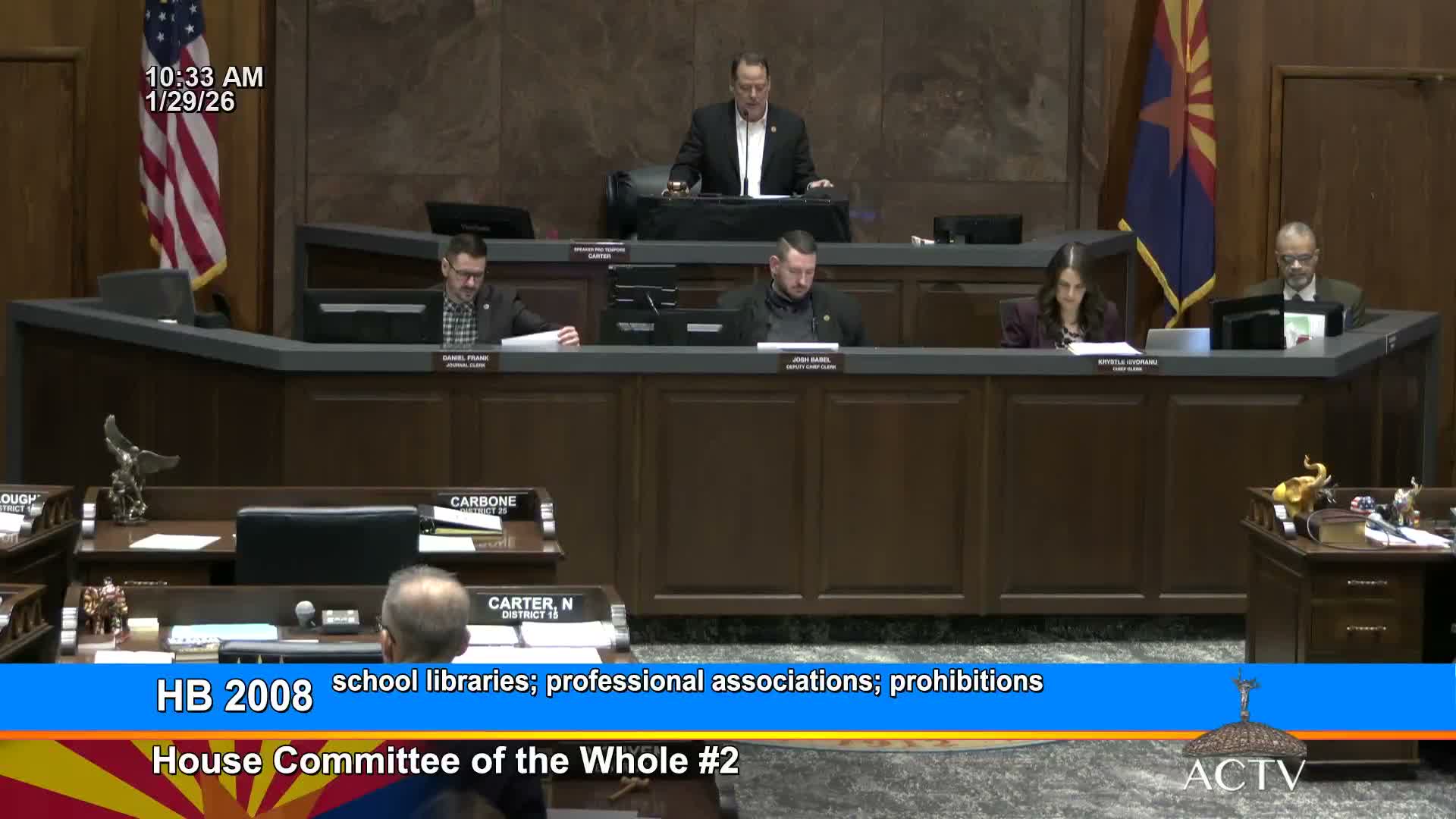
The House Committee of the Whole recommended a do-pass for HB 2008 after proponents said the bill would prevent public funds from supporting politically biased institutions and opponents warned it is an effort to censor libraries; the committee recorded a 33–23 standing vote.
Representative Copper introduced House Bill 2008 in the Committee of the Whole, saying the measure "came from the idea that unfortunately, the library associations across this nation... have a very strong political bias" and that his intent was "to not use public monies to fund institutions that are overly political biased." He urged members to support the bill.
Representative Semachek challenged the measure, calling it "part of a large effort to censor" libraries and arguing it would restrict access to information and undermine libraries' role "as democratic institutions." Semachek cited the American Library Association's Library Bill of Rights and said libraries should provide collections "that reflect a full spectrum of viewpoints and lived experiences."
Representative Koepper, closing for proponents, said the bill was aimed at the proper use of state funds, arguing "this is really just about the state making sure we are not spending public monies on any institution that's trying to teach sectarian information inside our public schools," and cited the Arizona Constitution's prohibition on sectarian education in public schools.
After debate, the committee called for a standing, counted vote. The clerk announced the result as 33 ayes and 23 nays, and the Committee of the Whole gave HB 2008 a do-pass recommendation. The committee's recommendation will be reported back to the full House for further procedural steps.
The transcript records the principal exchanges on record: Copper's statement of purpose, Semachek's opposition framed around library access and intellectual freedom, and Koepper's closing emphasis on fiscal limits and constitutional restrictions. No amendments or specific statutory language changes were read aloud during the floor discussion recorded in the transcript. The committee's vote was recorded in open session.